Best Roofing Shingles for Hot, Humid Virginia Summers
Best Roofing Shingles for Hot, Humid Virginia Summers
Key Takeaways
- The best roofing shingles for humid climate Virginia homes feature algae-resistant (AR) granules, SBS modified asphalt cores, and reflective technology that reduces heat absorption
- GAF Timberline HDZ, CertainTeed Landmark, and Owens Corning Duration are the three top-performing shingle lines for Northern Virginia's hot, humid summers
- Algae-resistant shingles use copper or zinc-infused granules to prevent the black streaking caused by Gloeocapsa magma, adding only $200 to $600 to a full roof replacement
- Cool roof shingles can reduce attic temperatures by 20 to 30 degrees and cut cooling costs by 7 to 15 percent in Virginia's climate zone
- SBS modified asphalt shingles outperform standard oxidized asphalt in Virginia because they maintain flexibility across the 150-degree-plus temperature swings between summer attics and winter freeze cycles
The best roofing shingles for humid climate Virginia homes need to do more than just keep water out. They need to resist algae growth in 90-degree humidity, flex without cracking through temperature swings that range from 150-degree attics in July to single digits in January, and reflect enough solar energy to keep your cooling bills from spiraling out of control between May and September. Virginia's climate zone 4A — classified as hot-humid by the Department of Energy — creates a specific set of demands that standard shingles designed for drier or milder regions simply aren't built to handle well.
If you live in Woodbridge, Dale City, Lake Ridge, or anywhere along the I-95 corridor through Prince William County, you've seen what humidity does to roofs. Those dark black streaks running down north-facing slopes aren't dirt — they're colonies of Gloeocapsa magma, a cyanobacteria that thrives in warm, moist environments and feeds on the limestone filler in standard shingle granules. Left unchecked, algae growth traps moisture against the shingle surface, accelerates granule loss, and can shorten a roof's functional lifespan by five to eight years. It also makes your home look neglected, which affects curb appeal and resale value.
This guide breaks down the shingle technologies, specific product lines, and material features that perform best in Virginia's humid climate. We'll cover algae-resistant AR technology, SBS modified asphalt, cool roof reflective shingles, and the three manufacturer product lines that consistently deliver the best results on Northern Virginia homes. Whether you're planning a roof replacement or researching options before you talk to a contractor, you'll finish this article knowing exactly what to ask for and why it matters for your home.
Why Virginia's Humid Climate Demands Specialized Shingles
Virginia doesn't get credit for how hard its climate is on roofing materials. Homeowners in hurricane zones or heavy snow regions understand that their roofs take a beating, but the combination of heat, humidity, UV exposure, and freeze-thaw cycling that Northern Virginia delivers is equally destructive — it just works more slowly and less dramatically.
The Woodbridge area averages 70 to 75 percent relative humidity during summer months, with many days exceeding 85 percent. That moisture-laden air doesn't just make you uncomfortable — it creates ideal growing conditions for algae, moss, and lichen on your roof. North-facing slopes that receive limited direct sunlight are especially vulnerable because they stay damp longer after morning dew and afternoon thunderstorms. Homes near the Occoquan Reservoir, Leesylvania State Park, and the Potomac River corridor face even higher localized humidity due to water proximity and tree canopy that limits air circulation across the roof surface.
Heat compounds the humidity problem. Attic temperatures in poorly ventilated Virginia homes routinely reach 140 to 160 degrees during July and August. That heat radiates through the roof deck and softens the asphalt binder in shingles from the underside while UV radiation degrades the granule surface from the top. Standard oxidized asphalt — the type used in most economy shingles — becomes brittle faster under these conditions. When winter arrives and temperatures drop below freezing, those already-stressed shingles crack and split at the expansion joints, creating entry points for water that freeze and expand further with each cycle.
The practical result: a shingle rated for 30 years in a mild, dry climate may deliver only 18 to 22 years in the Woodbridge area before it needs replacement. Choosing shingles specifically engineered for hot-humid performance closes that gap significantly and protects your investment over the long term.
Algae-Resistant Shingles: AR Technology Explained
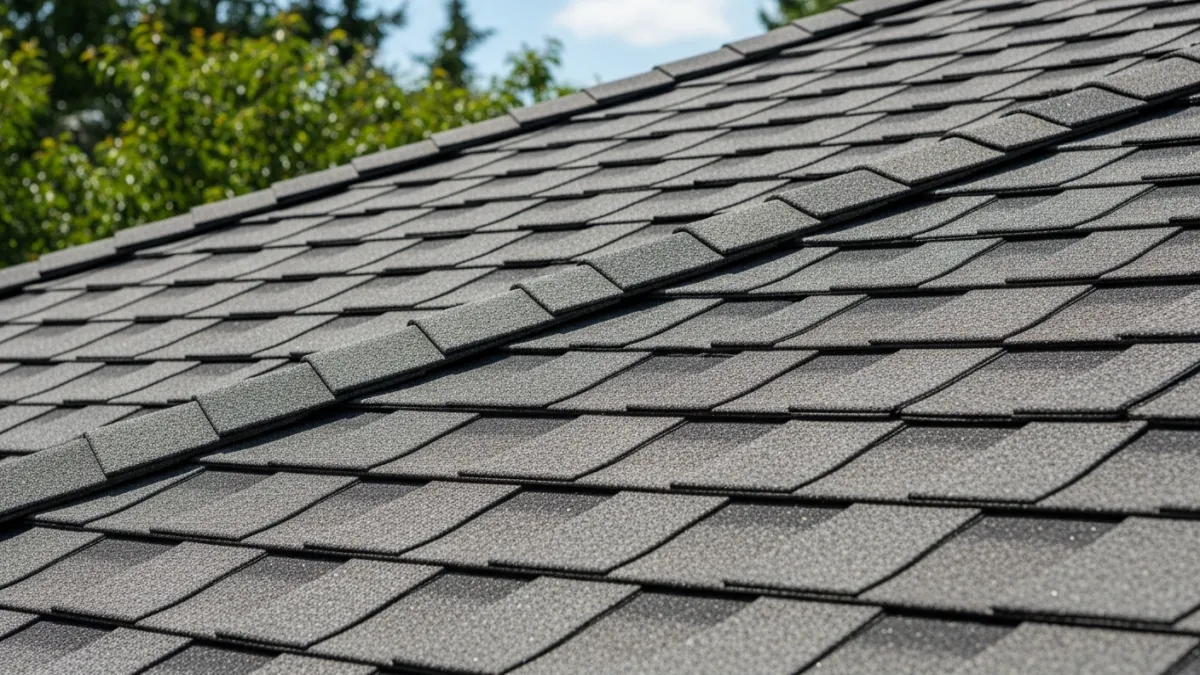
Algae-resistant shingles are the single most important upgrade for any Virginia homeowner replacing a roof. AR technology works by incorporating copper or zinc granules into the shingle surface. When rainwater washes over these metallic granules, it carries trace amounts of copper or zinc ions across the shingle surface. These ions create an environment that's hostile to Gloeocapsa magma and other biological organisms, preventing the colonies from establishing and spreading.
The science is straightforward and well-proven. Copper has been used as a biocide for centuries — it's the same reason copper roofs and copper flashing strips prevent algae growth on the shingles below them. Modern AR shingles embed copper-containing granules directly into the shingle manufacturing process so the protection is distributed across the entire surface rather than concentrated at a single strip near the ridge.
How AR Protection Works Over Time
AR granules release their protective ions gradually over the life of the shingle. Each rainfall activates a small amount of the copper or zinc content, which washes down the shingle surface and suppresses biological growth. The release rate is calibrated to provide protection for 10 to 25 years depending on the manufacturer and product line. Premium AR products like GAF's StainGuard Plus carry algae resistance warranties of 25 years, while standard AR products typically offer 10 to 15 years of coverage.
This distinction matters for Virginia homeowners. A 10-year algae resistance warranty on a shingle installed in the Woodbridge area may leave you with visible streaking during the second half of the roof's life. A 25-year warranty — like those offered on the premium product lines we recommend — provides protection that matches the functional lifespan of the shingle itself. Given that algae remediation (professional cleaning or premature replacement) can cost $500 to $2,000 or more, the upfront premium for extended AR protection pays for itself.
AR Shingles vs. Standard Shingles in Virginia
The performance gap between AR and non-AR shingles is dramatic in Virginia's climate. We've seen homes along Smoketown Road in Woodbridge where north-facing slopes without AR protection develop visible black streaking within three to five years of installation. Identical slopes on neighboring homes with AR shingles remain streak-free for 15 years or more. The difference in appearance is obvious from the street, and it directly affects both the homeowner's satisfaction and the home's resale value.
The cost difference is minimal. AR technology adds roughly $200 to $600 to a full roof replacement on a standard 2,000 square foot home. On a project that already costs $9,000 to $16,000, that's a 2 to 4 percent premium for protection that preserves your roof's appearance and structural integrity for decades. There is no rational reason to install non-AR shingles on a Virginia home in 2026.
SBS Modified Asphalt Shingles: Built for Temperature Extremes
SBS stands for styrene-butadiene-styrene, a synthetic rubber polymer that's blended into the asphalt during manufacturing. The result is a shingle that behaves fundamentally differently from standard oxidized asphalt when temperatures swing between extremes — which is exactly what happens in Virginia, where your roof deck can reach 160 degrees in August and drop below 10 degrees in January.
Standard oxidized asphalt shingles become brittle in cold weather, making them susceptible to cracking when ice forms, tree branches fall, or foot traffic occurs during winter inspections. In extreme heat, the same shingles become soft and pliable, which can lead to scuffing from foot traffic, granule displacement, and accelerated aging of the asphalt binder. SBS modified asphalt maintains its flexibility and resilience across the full temperature range, which translates directly to longer service life and fewer premature failures.
Impact Resistance and Hail Performance
The rubber content in SBS modified shingles also provides superior impact resistance. Virginia gets hail — not as frequently as the Midwest, but when summer thunderstorms roll through the Woodbridge area with quarter-inch to half-inch hail, the difference between standard and SBS shingles is measurable. Standard asphalt bruises and cracks under hail impact, creating weak points where granules separate and water penetrates. SBS modified asphalt absorbs the impact and bounces back without fracturing, maintaining the protective granule layer intact.
Several SBS modified shingle products carry Class 4 impact ratings under UL 2218 testing, which is the highest rating available. This rating can qualify you for insurance premium discounts of 5 to 28 percent depending on your carrier and policy — a financial benefit that can offset the higher upfront cost of SBS shingles over the life of the roof. Check with your insurance agent before selecting materials, because the discount varies significantly between carriers operating in Virginia.
How SBS Modified Compares to Standard Asphalt in Virginia
In practical terms, SBS modified asphalt shingles installed on Northern Virginia homes typically deliver three to seven additional years of functional lifespan compared to standard oxidized asphalt shingles of the same weight class. On a 2,000 square foot Woodbridge home, the upgrade from standard to SBS modified asphalt adds approximately $800 to $2,000 to the total project cost. When you divide that premium by the additional years of service, the cost per year of roof life often comes out lower with SBS than with standard asphalt — making it the better value even though it costs more upfront.
Cool Roof Shingles: Reducing Heat Absorption in Virginia Summers
Cool roof shingles use specially formulated granules that reflect a higher percentage of solar radiation compared to standard dark-colored shingles. Traditional dark shingles absorb 85 to 95 percent of the solar energy that hits them, converting it to heat that radiates into your attic and ultimately into your living space. Cool roof shingles reflect 25 to 40 percent of solar energy, significantly reducing the heat load on your roof deck and attic.
For energy-efficient roofing in Northern Virginia, the impact is meaningful. Attic temperatures in homes with cool roof shingles typically run 20 to 30 degrees lower than identical homes with standard dark shingles. That temperature reduction means your air conditioning system runs fewer hours per day during Virginia's four to five month cooling season, which translates to lower electricity bills and less wear on your HVAC equipment.
Energy Savings Calculation for Virginia Homes
The Department of Energy classifies Northern Virginia as climate zone 4A (mixed-humid), where cooling costs typically account for 30 to 45 percent of annual energy bills. A typical Woodbridge home spends $200 to $350 per month on electricity during June through September. Research from Oak Ridge National Laboratory shows cool roofing products can reduce cooling energy use by 7 to 15 percent in this climate zone.
Here's what that looks like in real numbers for a Woodbridge home:
- Summer electricity spending: $200 to $350 per month for four to five months = $800 to $1,750 per cooling season
- Cooling portion (estimated 60 to 70 percent of summer bills): $480 to $1,225 per season
- Cool roof reduction (7 to 15 percent of cooling costs): $34 to $184 per season
- Over a 25-year roof life: $850 to $4,600 in cumulative cooling savings
The savings are most significant on homes with limited attic insulation, older single-stage HVAC systems, or large roof areas with west-facing exposure. Homes in newer communities like Belmont Bay and Potomac Club with modern insulation and high-efficiency HVAC systems will see savings toward the lower end of the range, but the reduction in attic heat still extends shingle lifespan by reducing thermal stress on the asphalt from the underside.
Cool Roof Shingle Color Options
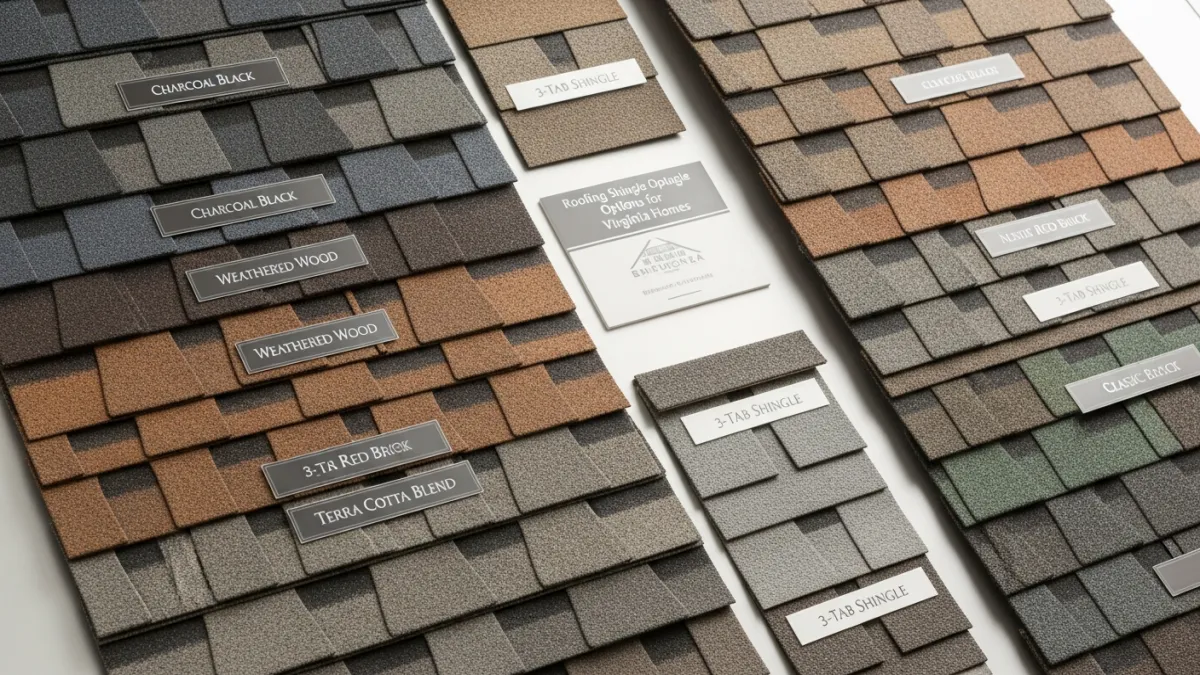
Early cool roof products were limited to light colors — white, light gray, and tan — which restricted their appeal for homeowners who preferred traditional darker roof colors. Modern cool roof shingles have overcome this limitation. Manufacturers now produce cool roof granules in medium tones including charcoal, weathered wood, and dark brown that meet ENERGY STAR reflectance standards while maintaining the appearance homeowners expect. You no longer have to choose between energy efficiency and curb appeal.
Top Shingle Products for Virginia's Humid Climate
Three manufacturer product lines consistently deliver the best combination of algae resistance, durability, wind performance, and value for Northern Virginia homes. Each has specific strengths that make it worth considering depending on your priorities and budget. Here's an honest comparison based on our experience installing all three on roofing projects throughout Woodbridge and Prince William County.
GAF Timberline HDZ
The GAF Timberline HDZ is the best-selling shingle in North America, and it earns that position through a combination of performance features that align well with Virginia's climate demands. The HDZ uses GAF's LayerLock technology, which mechanically fuses the shingle layers together during installation, creating a monolithic bond that resists wind uplift more effectively than traditional adhesive-only sealing. The result is a 130 mph wind warranty that doesn't require special installation methods — the standard nailing pattern achieves the full warranty.
For humid climate performance, the Timberline HDZ includes StainGuard Plus AR protection, which provides a 25-year limited warranty against algae discoloration. The copper-containing granules are distributed across the full shingle surface, providing consistent protection on every course. The HDZ is also available in cool roof colors that meet ENERGY STAR requirements, allowing you to combine algae resistance with solar reflectance in a single product.
The Timberline HDZ is compatible with GAF's system warranty approach, where using matching GAF accessories (starter strip, ridge cap, underlayment, leak barrier) qualifies for an enhanced system warranty of up to 50 years with 25 years of 100 percent coverage on both labor and materials. For Virginia homeowners who want the strongest warranty protection available, the GAF system approach offers genuine value.
CertainTeed Landmark
The CertainTeed Landmark series has been a staple of Northern Virginia roofing for decades, and the current generation delivers strong humid-climate performance through its StreakFighter algae resistance technology. StreakFighter uses copper-infused granules similar to competing AR systems, with a warranty period that varies by product tier — the standard Landmark carries 10-year AR coverage, while the Landmark PRO and Landmark Premium extend that to 15 and 25 years respectively.
What sets the CertainTeed Landmark apart is its dual-layer construction, which creates a thick, dimensional profile that mimics the look of natural wood shakes. The shingle's weight — heavier than most competing products in the same price tier — contributes to both wind resistance and durability. CertainTeed rates the Landmark series for winds up to 110 mph on the standard product and 130 mph on the Landmark PRO with the enhanced wind warranty option.
CertainTeed also offers the Landmark series in NorthGate, a premium SBS modified asphalt version that combines the Landmark's appearance and AR protection with the flexibility and impact resistance of SBS rubber-modified asphalt. The NorthGate carries a Class 4 impact rating and is an excellent choice for Virginia homeowners who want the best combination of algae resistance, impact protection, and thermal cycling durability in a single product.
Owens Corning Duration
The Owens Corning Duration uses SureNail technology — a fabric strip embedded in the nailing zone that provides consistent, secure fastener engagement regardless of where the installer drives the nail within the designated zone. This feature addresses one of the most common installation-quality issues in roofing: nails placed too high or too low in the shingle, which weakens wind resistance and can void the manufacturer's warranty. SureNail makes proper nailing almost foolproof, which improves real-world performance on every roof where it's installed.
The Duration series includes algae resistance across the full product line, with the standard Duration offering 10-year AR coverage and the Duration STORM carrying enhanced impact resistance along with algae protection. Owens Corning rates the Duration for wind speeds up to 130 mph, and the TRU PROtection warranty period extends to lifetime coverage when installed with matching Owens Corning accessories.
For Virginia's humid climate specifically, the Duration FLEX is worth considering. This product uses SBS modified asphalt for enhanced flexibility and carries a Class 4 impact rating. Combined with the SureNail fastening system and standard AR protection, the Duration FLEX addresses all three of the major Virginia climate challenges — humidity, temperature extremes, and storm impact — in a single shingle.
| Product | AR Protection | Wind Rating | SBS Modified | Best For |
|---|---|---|---|---|
| GAF Timberline HDZ | 25-year StainGuard Plus | 130 mph | No (standard asphalt) | Best overall value, system warranty |
| CertainTeed Landmark PRO | 15-year StreakFighter | 130 mph | No (available in NorthGate) | Premium appearance, heavy weight |
| CertainTeed NorthGate | 25-year StreakFighter | 130 mph | Yes (Class 4 impact) | Maximum durability, hail protection |
| Owens Corning Duration | 10-year standard | 130 mph | No (available in FLEX) | Reliable fastening, contractor-friendly |
| Owens Corning Duration FLEX | 10-year standard | 130 mph | Yes (Class 4 impact) | SBS flexibility + SureNail tech |
Humidity and Mold Prevention: Beyond the Shingle
Choosing the right shingle is essential, but it's only one part of a humidity-resistant roofing system. The components beneath and around your shingles play an equally important role in preventing moisture damage, mold growth, and premature failure in Virginia's climate.
Attic Ventilation: The Foundation of Moisture Control
Proper attic ventilation is the single most important factor in preventing moisture-related problems on Virginia roofs. The principle is simple: cool, dry air enters through soffit vents at the eaves and exits through ridge vents at the peak, creating continuous airflow that removes heat and moisture from the attic space. When this system works correctly, it reduces attic temperatures by 20 to 40 degrees in summer and prevents condensation buildup in winter.
The industry standard is one square foot of net free ventilation area for every 150 square feet of attic floor space (1:150 ratio), or 1:300 when the ventilation is balanced between intake and exhaust. On a 2,000 square foot Woodbridge home, that means approximately 7 to 14 square feet of total vent area, split evenly between soffit intake and ridge exhaust.
Ventilation failures are common on older Woodbridge homes. We frequently find soffit vents blocked by insulation that was blown in without baffles, ridge vents that have been painted over or clogged with debris, and gable vents that short-circuit the airflow path by allowing air to move horizontally through the attic rather than vertically from eave to ridge. Any of these conditions trap heat and moisture in the attic, accelerating shingle deterioration from the underside regardless of how premium the shingle product is on the surface.
Synthetic Underlayment for Moisture Protection
Synthetic underlayment has largely replaced traditional 15-pound felt paper on quality installations in Northern Virginia. Synthetic products are lighter, stronger, lay flatter, and provide better moisture resistance than felt. They also resist tearing during installation and don't wrinkle when exposed to humidity before the shingles are applied — a real-world advantage during Virginia's humid summer installation season when felt paper can absorb moisture and buckle overnight.
For maximum protection in Virginia's climate, we recommend ice-and-water shield membrane at all eaves (extending at least 24 inches past the interior wall line), in all valleys, and around every penetration including chimneys, skylights, pipe boots, and wall transitions. This self-adhering membrane creates a fully waterproof secondary barrier at the areas most vulnerable to wind-driven rain and ice dam backup.
Tree Management and Roof Exposure
Virginia's mature tree canopy is one of the features that makes neighborhoods along the Occoquan, near Prince William Forest Park, and throughout older sections of Woodbridge so attractive. But overhanging branches create specific problems for roof longevity in a humid climate. Branches that shade the roof reduce sunlight exposure, keeping surfaces damp longer and creating ideal conditions for algae, moss, and lichen growth. Falling leaves and pine needles accumulate in valleys and behind dormers, trapping moisture and decomposing organic material directly against the shingle surface.
Trim branches back at least six feet from the roof surface. This allows adequate sunlight and air circulation to dry the roof after rain and morning dew. It also reduces the amount of debris that accumulates on the roof and in gutters, and eliminates the physical abrasion from branches rubbing against shingles during wind events.
Cost of Humidity-Resistant Shingles in Northern Virginia
Understanding what best roofing shingles for humid climate Virginia homes actually cost helps you budget accurately and evaluate contractor proposals. Northern Virginia prices run 15 to 25 percent above national averages due to higher labor rates, permit requirements, and material logistics. The figures below represent total installed costs including labor, materials, tear-off, and disposal for a standard 2,000 square foot home with a 6:12 pitch.
| Shingle Type / Product | Low End | High End | Notes |
|---|---|---|---|
| Standard AR architectural shingle | $9,000 | $14,500 | GAF HDZ, CertainTeed Landmark, OC Duration |
| Premium AR architectural shingle | $11,000 | $16,000 | Extended AR warranty, thicker profile |
| SBS modified asphalt shingle | $12,500 | $19,000 | CertainTeed NorthGate, OC Duration FLEX |
| Cool roof shingle upgrade | $300 | $800 | Additional cost for reflective granules |
| AR upgrade (non-AR to AR shingles) | $200 | $600 | Minimal premium for essential protection |
| SBS upgrade (standard to SBS asphalt) | $800 | $2,000 | Adds 3-7 years lifespan, impact resistance |
| Permit — Prince William County | $75 | $250 | Required for full replacement |
| Ventilation upgrade (new ridge + soffit) | $400 | $1,200 | Critical for humidity control |
Factors That Move Your Price Up or Down
Several variables determine where your project falls within these ranges:
- Roof pitch: Steeper roofs require more safety equipment, take longer to work on, and use more material. A 12:12 pitch costs noticeably more than a 4:12
- Roof complexity: Dormers, valleys, skylights, chimneys, and intersecting planes add labor and material. Simple gable roofs cost less; multi-hip roofs with dormers cost more
- Existing layers: Removing two layers of old shingles generates more labor and disposal cost than removing one
- Decking condition: Damaged decking discovered during tear-off adds $75 to $150 per 4x8 sheet
- Manufacturer system: Using all matching manufacturer accessories to qualify for enhanced system warranties adds material cost but significantly improves warranty coverage
- Season: Projects scheduled during peak season (April through October) may carry higher prices due to demand
Prices shown are typical ranges for Northern Virginia as of 2026 and vary based on home size, material grade, site access, and current material costs. Contact us for a free on-site estimate.
The most reliable way to know what your specific project will cost is to schedule an inspection. We provide detailed, itemized estimates at no charge. Book a free consultation and we'll walk through the options that make sense for your home and budget.
How to Choose the Right Shingle for Your Virginia Home
With multiple product lines and upgrade options available, the decision can feel overwhelming. Here's a practical framework for narrowing your choice based on your specific situation.
If You're on a Budget
Choose a standard AR architectural shingle from any of the three major manufacturers. The GAF Timberline HDZ offers the best combination of value and long-term AR protection (25-year StainGuard Plus) at the standard price point. Don't skip the AR feature to save $200 to $600 — non-AR shingles in Virginia will streak within three to five years, and professional cleaning costs $300 to $600 per treatment.
If You Want Maximum Durability
Choose an SBS modified asphalt product like the CertainTeed NorthGate or Owens Corning Duration FLEX. The SBS rubber modifier provides superior temperature cycling resistance and impact protection, and the Class 4 impact rating may reduce your insurance premiums. This is the right choice if you plan to stay in your home for 15 or more years and want to maximize the interval before your next replacement.
If Energy Efficiency Is a Priority
Choose a cool roof color option within your preferred product line. All three manufacturers offer ENERGY STAR-qualified colors in their standard product lines. Combine cool roof shingles with a ventilation upgrade during the replacement to maximize both the cooling benefit and the longevity of the new shingle system. For more on this topic, see our guide on choosing the best roofing shingles for Virginia homes.
If You're Selling Soon
Choose a standard AR architectural shingle in a neutral color that appeals to the broadest range of buyers. Weathered Wood, Charcoal, and Driftwood are consistently popular across Northern Virginia neighborhoods. The investment in AR protection pays off especially fast on resale because a streak-free roof photographs better and creates a stronger first impression than a roof already showing algae discoloration.
Maintenance Tips for Humid Climate Roofs in Virginia
Even the best shingles require basic maintenance to deliver their full lifespan in Virginia's climate. These practices are especially important for homes in humid areas along the Occoquan corridor, near the Potomac, and in heavily wooded neighborhoods throughout Prince William County.
- Annual inspection: Have your roof inspected every year, ideally in spring after winter freeze-thaw cycles and before summer heat begins. A professional inspection catches small issues — lifted shingles, cracked flashing, deteriorating pipe boots — before they become expensive problems
- Gutter cleaning: Clean gutters at least twice per year, in late fall after leaves drop and in late spring. Clogged gutters cause water to back up under shingle edges, which accelerates rot and provides a moisture source for algae growth
- Tree trimming: Maintain a six-foot clearance between tree branches and the roof surface. This improves air circulation, reduces shade-related moisture retention, and eliminates physical abrasion from branch contact during storms
- Debris removal: Clear leaves, pine needles, and organic debris from valleys, behind dormers, and around penetrations. Trapped debris holds moisture against the shingle surface and promotes biological growth
- Ventilation checks: Verify that soffit vents are not blocked by insulation and that ridge vents are clear of debris. A blocked vent defeats the purpose of the entire ventilation system and allows heat and moisture to accumulate in the attic
- Avoid pressure washing: Never pressure wash asphalt shingles. The high-pressure stream strips granules from the surface, voids the manufacturer warranty, and shortens the roof's lifespan. If cleaning is needed, use a low-pressure chemical treatment applied by a professional
Ready to Choose the Right Shingles for Your Virginia Home?
Get a free, no-pressure estimate from Woodbridge Roofers. We'll inspect your roof, walk you through the best shingle options for your home's specific needs, and give you an honest assessment. Call us at (571) 570-7930 or schedule online.
Schedule Free ConsultationFrequently Asked Questions
Conclusion
Choosing the best roofing shingles for humid climate Virginia homes comes down to three core features: algae-resistant granules that prevent the black streaking caused by Gloeocapsa magma, SBS modified asphalt that maintains flexibility across Virginia's extreme temperature range, and reflective technology that reduces heat absorption during our four to five month cooling season. The GAF Timberline HDZ, CertainTeed Landmark series, and Owens Corning Duration line all offer products that address these challenges effectively, with specific premium tiers that combine all three features in a single shingle.
Don't install a shingle designed for a mild, dry climate on a Woodbridge home and expect it to perform for 25 years. Virginia's humidity, heat, and temperature cycling will expose every weakness in a material that wasn't engineered for these conditions. Invest in the right product upfront, pair it with proper ventilation and maintenance, and your roof will protect your family and your home's value for decades. If you're ready to discuss the best shingle options for your specific home, call Woodbridge Roofers at (571) 570-7930 or book a free phone consultation. We'll inspect your roof, walk you through the products that make sense for your situation, and give you an honest, itemized estimate.