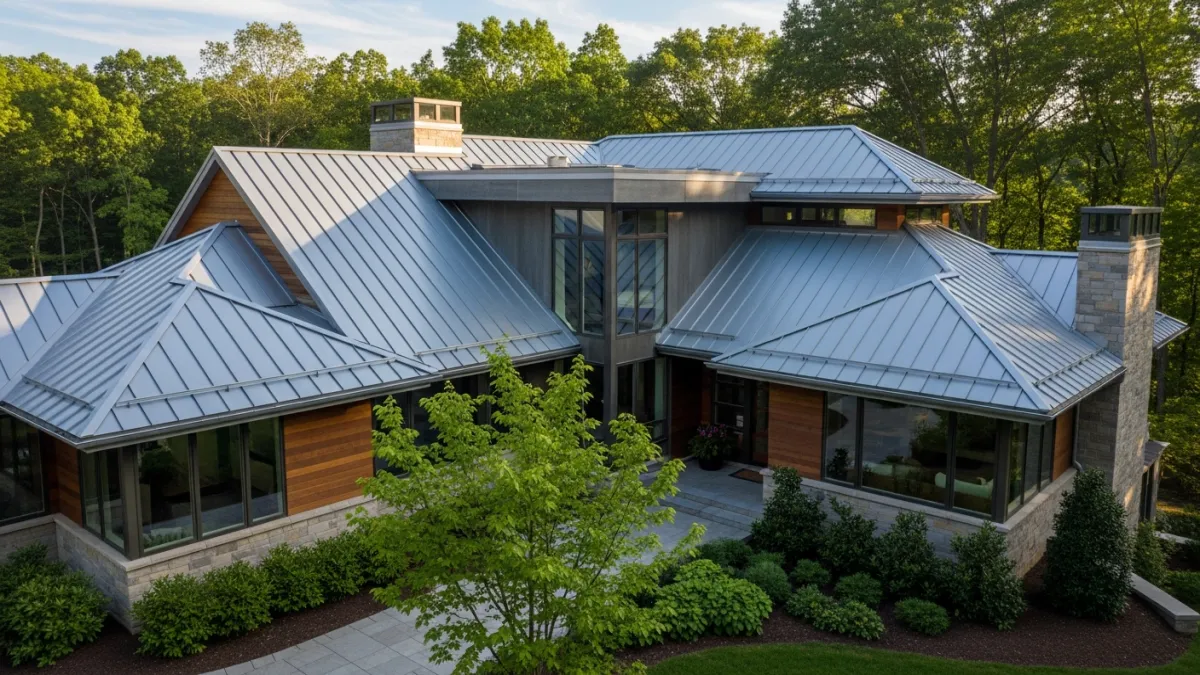
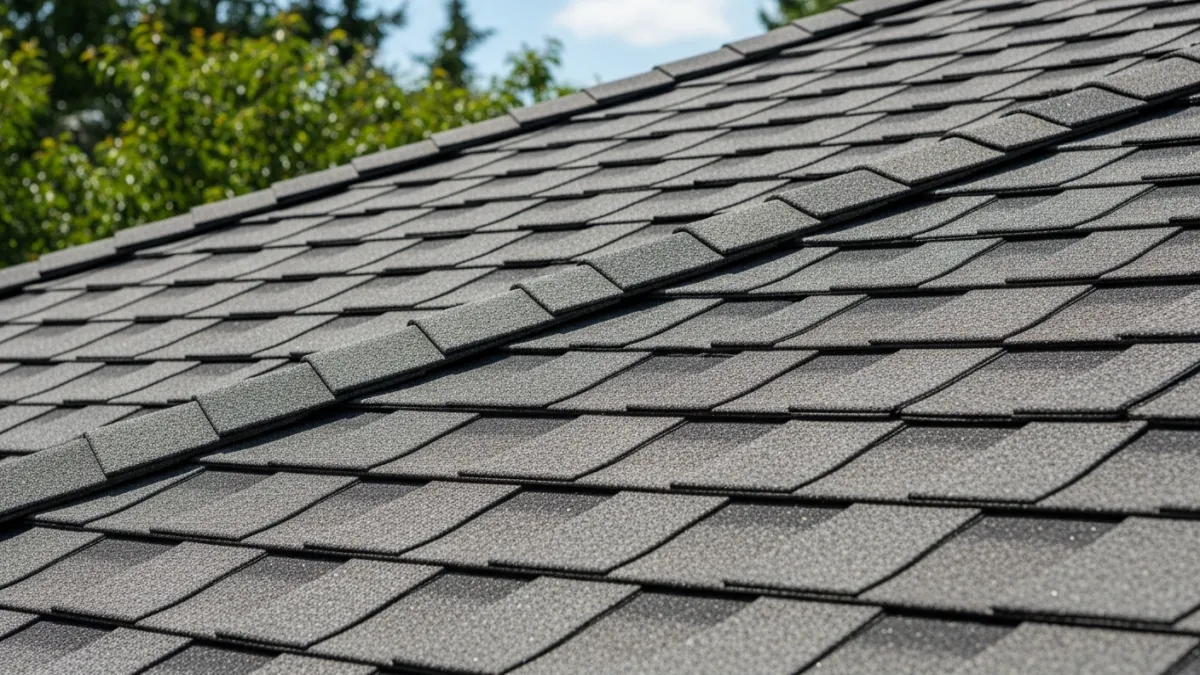
Asphalt Shingle Roofing: The Best Choice for Virginia Homes?
Asphalt Shingle Roofing: The Best Choice for Virginia Homes?
Key Takeaways
- Architectural asphalt shingles are the best overall roofing choice for most Virginia homes, offering 20 to 28 years of performance with proper ventilation
- The top three shingle lines installed in Northern Virginia are GAF Timberline HDZ, CertainTeed Landmark, and Owens Corning Duration
- Virginia's heat, humidity, UV exposure, and freeze-thaw cycles demand shingles with strong granule adhesion and algae-resistance ratings
- Impact-resistant Class 4 shingles can earn you a 5 to 15 percent insurance discount while protecting against hail damage
- Installed costs for a 2,000 square foot home in Northern Virginia range from $8,500 to $18,000 depending on the shingle grade you select
The best roofing shingles for Virginia weather are architectural asphalt shingles with algae-resistant granules and wind ratings of 130 mph or higher. These products handle the state's demanding four-season climate — summer heat reaching the mid-90s, winter freeze-thaw cycles, spring thunderstorms with straight-line winds, and year-round humidity that promotes algae and moss growth. Three-tab shingles are largely obsolete for new installations here, and for good reason.
Choosing the right shingle for your Northern Virginia home isn't just about picking a color from a sample board. The product line you select determines how your roof performs against wind uplift during severe thunderstorms, how quickly algae streaks appear on north-facing slopes, how well the shingles hold their granules through 20-plus years of thermal cycling, and ultimately how long your roof lasts before you're facing another replacement. This guide breaks down every shingle category available to Virginia homeowners, compares the leading brands head to head, explains the cost differences, and helps you make a confident decision based on your specific home and budget.
Why Virginia Weather Is Hard on Roofing Shingles
Virginia sits in a climate zone that tests roofing materials from every direction. Understanding what your shingles face throughout the year explains why some products outperform others in this region and why national product reviews don't always apply to Northern Virginia homes.
Summer Heat and UV Exposure
Ambient temperatures in Woodbridge, Fairfax, and Prince William County regularly exceed 90 degrees from June through September. Attic temperatures in homes with inadequate ventilation can reach 140 to 160 degrees. This sustained heat accelerates the oxidation of the asphalt binder that holds shingle granules in place. Over years, the binder dries out, becomes brittle, and loses its grip. Granules wash into the gutters, exposing the fiberglass mat underneath to direct UV radiation, which accelerates deterioration further. Homeowners looking to reduce heat absorption should also explore energy-efficient roofing options. The homes along Route 1 in Woodbridge and throughout the Dale City corridor see this cycle play out on south-facing and west-facing roof slopes especially.
Humidity and Algae Growth
Northern Virginia's humidity levels routinely exceed 70 percent during summer months. This moisture-rich environment promotes the growth of Gloeocapsa magma — a blue-green algae that feeds on the limestone filler in shingle granules. The result is the dark streaking you see on roofs throughout neighborhoods like Lake Ridge, Montclair, and Potomac Mills area homes. Beyond aesthetics, algae holds moisture against the shingle surface and accelerates granule loss. Shingles manufactured with copper or zinc granules resist algae growth for 10 to 15 years, making algae resistance a non-negotiable feature for Virginia installations. For more on this topic, see our guide to the best roofing shingles for humid Virginia summers.
Freeze-Thaw Cycles
Virginia winters bring frequent temperature swings above and below 32 degrees. Water that seeps into hairline cracks in shingles or beneath lifted edges expands when it freezes, widening the crack or breaking the adhesive seal. This happens repeatedly from November through March — sometimes multiple times in a single week. Over a 20-year period, hundreds of freeze-thaw cycles cumulatively weaken shingle integrity, particularly at the edges and in valleys where water concentration is highest.
Wind and Storm Events
Severe thunderstorms with straight-line winds of 60 to 80 mph hit Northern Virginia multiple times each summer. Tropical storm remnants occasionally bring sustained winds even higher. Wind damage to shingles occurs when the adhesive strip between overlapping shingles fails, allowing the wind to catch the exposed edge and peel the shingle back or tear it off entirely. Shingles with higher wind ratings — 130 mph for standard architectural products, up to 150 mph for premium lines — resist uplift significantly better than basic three-tab products rated to only 60 or 70 mph.
Types of Asphalt Shingles Available in Virginia
Asphalt shingles fall into three main categories, each with different performance characteristics, appearance, lifespan, and cost. Here's what you need to know about each one before making your selection.
Three-Tab Shingles
Three-tab shingles are the original asphalt roofing product. They consist of a single layer of fiberglass mat coated with asphalt and topped with ceramic-coated mineral granules. The three tabs create a flat, uniform appearance when installed. They are the lightest and least expensive asphalt shingle, but they are also the least durable. In Virginia's climate, three-tab shingles typically last 15 to 20 years — and often less on south-facing slopes that take the brunt of summer heat.
Wind resistance is their biggest weakness. Most three-tab products carry wind ratings of only 60 to 70 mph, which means they are vulnerable to damage during the severe thunderstorms that regularly affect the Woodbridge, Manassas, and Fairfax corridors. The adhesive strips on three-tab shingles are narrower and less robust than those on architectural products, making them more prone to wind-driven peel-back.
Very few contractors recommend three-tab shingles for new installations in Northern Virginia today. The cost savings compared to architectural shingles is roughly $1,000 to $2,000 on a typical home, but the reduction in lifespan and wind performance makes that savings a poor trade-off for most homeowners.
Architectural (Dimensional) Shingles
Architectural shingles — also called dimensional or laminate shingles — are the standard for residential roofing across Virginia. They consist of two or more layers of fiberglass mat laminated together, creating a thicker, heavier shingle with a textured, three-dimensional appearance. This layered construction provides better wind resistance, longer lifespan, and a more attractive look compared to three-tab products.
The leading architectural shingle lines installed in Northern Virginia include:
- GAF Timberline HDZ: The most installed shingle in North America. Features LayerLock technology for a mechanical nail-zone bond, StainGuard Plus algae protection rated for 25 years, and a 130 mph wind warranty. Available in a wide color palette that works with the colonial, Cape Cod, and contemporary home styles common throughout Woodbridge and Prince William County
- CertainTeed Landmark: A dual-layer architectural shingle with excellent color depth and a natural wood-shake look. Features NovaTech algae-resistance technology and carries a 110 mph wind rating. Popular in Fairfax County neighborhoods where HOA aesthetic standards are strict
- Owens Corning Duration: Features SureNail technology — a reinforced nailing zone strip that provides consistent nail placement and enhanced wind resistance up to 130 mph. The TruDefinition color platform offers rich, multi-tonal color blends
Architectural shingles deliver 20 to 28 years of service in Virginia when installed over properly ventilated attic spaces. They are the sweet spot of value, durability, and appearance for most homeowners in the region.
Premium Designer Shingles
Designer shingles represent the top tier of asphalt roofing. These products are engineered to replicate the look of natural slate or cedar shake while maintaining the installation simplicity and affordability of asphalt. They are thicker and heavier than standard architectural shingles, with deeper shadow lines and more complex color blending.
Popular designer lines for Virginia homes include:
- GAF Camelot II: A luxury shingle with an artisan-crafted look reminiscent of old-world European slate. Enhanced wind resistance up to 130 mph and StainGuard Plus algae protection
- CertainTeed Grand Manor: A multi-layered designer shingle that provides the most realistic slate appearance available in asphalt. Weighs approximately 480 pounds per square (100 square feet), making it one of the heaviest asphalt shingles on the market
- Owens Corning Berkshire: A premium laminate designed to replicate natural slate with rich, authentic colors. Features a lifetime limited warranty and enhanced wind resistance
Designer shingles typically last 25 to 35 years in Virginia and cost 40 to 60 percent more than standard architectural products. They make the most sense on higher-value homes where curb appeal directly affects property value — neighborhoods like Old Bridge Estates in Lake Ridge, Belmont Bay, and the established communities along Minnieville Road.
Impact-Resistant (Class 4) Shingles
Impact-resistant shingles are engineered to withstand hail without cracking or losing granules. They pass the UL 2218 Class 4 impact test, which involves dropping a two-inch steel ball from 20 feet onto the shingle surface without causing cracking or fracture. This is the highest impact rating available.
The most commonly installed impact-resistant shingles in Virginia include:
- GAF Timberline AS II: Combines the popular Timberline profile with a rubberized asphalt formulation that absorbs hail impact without cracking. Carries both Class 4 impact and 130 mph wind ratings
- CertainTeed NorthGate: Features SBS (styrene-butadiene-styrene) modified asphalt that stays flexible even in cold weather, resisting both impact damage and thermal cracking through Virginia winters
- Owens Corning Duration FLEX: An SBS-modified architectural shingle with Class 4 impact resistance and enhanced flexibility for cold-weather performance
The practical advantage of impact-resistant shingles in Virginia extends beyond damage prevention. Many insurance companies offer premium discounts of 5 to 15 percent on the dwelling coverage portion of your homeowners policy when you install Class 4 rated shingles. On a policy with $400,000 in dwelling coverage, that discount could save you $200 to $600 per year. Over a 25-year roof life, those savings can exceed the upfront cost difference. Check with your insurer before installation to confirm the discount applies to your specific policy.
Shingle Comparison: Head to Head
This table compares the four main categories of asphalt shingles across the factors that matter most for Virginia homeowners.
| Feature | Three-Tab | Architectural | Designer | Impact-Resistant |
|---|---|---|---|---|
| Lifespan (Virginia) | 15-20 years | 20-28 years | 25-35 years | 20-30 years |
| Wind Rating | 60-70 mph | 110-130 mph | 110-130 mph | 110-130 mph |
| Impact Rating | Class 1-2 | Class 1-3 | Class 2-3 | Class 4 |
| Algae Resistance | Optional | Standard (10-25 yr) | Standard (15-25 yr) | Standard (10-25 yr) |
| Weight (per square) | 200-240 lbs | 240-320 lbs | 350-480 lbs | 250-330 lbs |
| Appearance | Flat, uniform | Dimensional, textured | Slate or shake replica | Dimensional, textured |
Choosing the Right Shingle for Your Virginia Home
The right shingle depends on your budget, how long you plan to stay in your home, your neighborhood's aesthetic standards, and your risk tolerance for storm damage. Here's a practical decision framework.
Budget-Conscious Homeowners
If you're working within a tight budget, a standard architectural shingle like GAF Timberline HDZ or CertainTeed Landmark provides the best value. You get a 25 to 30 year manufacturer warranty, 130 mph wind resistance, algae protection, and an attractive dimensional appearance — all at a price that's only $1,000 to $2,000 more than a three-tab product that would need replacement 5 to 10 years sooner. This is the most popular choice in neighborhoods throughout Dale City, Woodbridge, and the broader Prince William County market.
Long-Term Homeowners
If you plan to stay in your home for 15 or more years, the premium designer or impact-resistant categories deserve serious consideration. The higher upfront cost translates to more years before the next replacement. A designer shingle lasting 30 years costs roughly 50 percent more than an architectural shingle lasting 23 years, but you avoid a second replacement cycle entirely. When you factor in the disruption, rising material costs, and inflation-adjusted labor rates 23 years from now, spending more today often costs less over the life of your home.
Homes in Hail-Prone or High-Wind Areas
If your home has experienced hail damage in the past or sits in an area where severe thunderstorms regularly produce damaging hail, impact-resistant shingles provide both physical protection and financial benefits through insurance discounts. The SBS-modified asphalt in products like the GAF Timberline AS II and CertainTeed NorthGate also stays more flexible in cold weather, which reduces the risk of thermal cracking during Virginia's winter freeze-thaw cycles.
HOA Communities
Many Northern Virginia communities have architectural review committees that must approve your shingle selection before installation begins. HOAs in neighborhoods like Montclair, Stonebridge, and Belmont Bay often specify acceptable color ranges and may require architectural or premium grade shingles. Your contractor should be familiar with the HOA process in your community and can often recommend colors and styles that pass review without issues.
The Role of Ventilation in Shingle Performance
No shingle — regardless of brand, grade, or price — performs to its potential without proper attic ventilation. This is the most overlooked factor in roof longevity in Virginia, and it's worth understanding before you spend a dollar on new shingles.
Proper ventilation requires balanced intake and exhaust. Cool outside air enters through soffit vents along the eaves, flows upward through the attic space, and exits through ridge vents or other exhaust vents at the peak. This airflow serves two critical functions: it removes heat in summer, reducing the temperature difference between the exterior shingle surface and the attic-side surface, and it removes moisture in winter, preventing condensation that can rot the decking from below.
The industry standard is 1 square foot of net free ventilation area for every 150 square feet of attic floor space (or 1:300 with a vapor barrier). Many older homes in the Woodbridge and Dale City areas were built with inadequate soffit ventilation, blocked soffit baffles from blown-in insulation, or insufficient ridge vent length. Installing premium shingles over a poorly ventilated attic is like putting high-performance tires on a car with bad alignment — the product can't deliver its rated lifespan because the conditions underneath are working against it.
When we evaluate a roof for replacement in Northern Virginia, we always assess the ventilation system and recommend improvements where needed. Adding or extending soffit vents, clearing insulation baffles, and upgrading to continuous ridge vent costs relatively little compared to the shingle investment it protects.
Understanding Shingle Warranties
Shingle warranties can be confusing because the numbers manufacturers print on the packaging don't always reflect real-world expectations. Here's how to read them intelligently.
Manufacturer Material Warranty
Major manufacturers offer "lifetime" warranties on architectural and designer shingles. In practice, "lifetime" means the expected useful life of the product, and the warranty coverage prorates significantly after the first 10 to 15 years. If your shingle fails in year 22 of a "lifetime" warranty, you may receive credit for only a fraction of the replacement material cost — and labor is typically not covered at all. Read the fine print. The more meaningful metric is the non-prorated period, which ranges from 10 years on standard products to 15 or 20 years on premium lines.
Wind and Algae Warranties
Wind warranties range from 60 mph on three-tab shingles to 130 or 150 mph on architectural and premium products. These warranties typically require that the shingles were installed according to the manufacturer's exact specifications, including the correct number and placement of fasteners. Algae resistance warranties — usually 10 to 25 years — guarantee that the copper or zinc granule technology will prevent unsightly black streaking. Both warranties can be voided by improper installation, making your choice of contractor as important as your choice of shingle.
Contractor Workmanship Warranty
Separate from the material warranty, your contractor should offer a workmanship warranty covering installation defects. These range from 2 years with independent contractors to 10 or more years with certified installer programs. GAF's Master Elite program, CertainTeed's SELECT ShingleMaster program, and Owens Corning's Platinum Preferred program all offer enhanced workmanship warranties when you use a certified contractor. These certifications require the contractor to meet specific training, insurance, and performance standards — they're not just marketing labels.
Shingle Cost in Northern Virginia
Understanding what roofing shingles cost in Virginia requires knowing that Northern Virginia prices run 15 to 25 percent above national averages. This premium reflects higher labor rates, material logistics costs, stricter permitting, and the generally higher cost of business in the DMV metro area. The figures below are based on a standard 2,000 square foot home with a 6:12 pitch and include materials, labor, tear-off, and disposal.
| Shingle Type | Low End | High End | Notes |
|---|---|---|---|
| Three-tab shingles (2,000 sq ft) | $7,000 | $11,000 | Rarely recommended for new installs |
| Architectural shingles (2,000 sq ft) | $8,500 | $15,000 | Best value, most popular choice |
| Impact-resistant shingles (2,000 sq ft) | $10,000 | $16,500 | Insurance discounts may offset cost |
| Premium designer shingles (2,000 sq ft) | $12,000 | $18,000 | Slate/shake look, longest lifespan |
| Tear-off and disposal (single layer) | $1,000 | $2,500 | Usually included in total price |
| Decking replacement (per 4x8 sheet) | $75 | $150 | Quantity found during tear-off |
| Permit — Prince William County | $75 | $250 | Required for full replacement |
Cost Per Square: A Useful Calculation
Roofing is measured in "squares" — one square equals 100 square feet of roof area. A 2,000 square foot home typically has 22 to 28 squares of roof area depending on pitch and complexity. For a quick budget estimate, multiply your roof area in squares by these installed cost-per-square ranges for Northern Virginia:
- Three-tab: $300 to $425 per square installed
- Architectural: $375 to $575 per square installed
- Impact-resistant: $425 to $650 per square installed
- Designer: $500 to $725 per square installed
For example, a home with 25 squares of roof area using architectural shingles would fall in the $9,375 to $14,375 range before adding decking replacement, specialty flashing, or permit fees. This calculation gives you a realistic starting point for budgeting before you get formal estimates.
Prices shown are typical ranges for Northern Virginia as of 2025 and vary based on home size, material grade, site access, and current material costs. Contact us for a free on-site estimate.
What to Look for in a Shingle Beyond the Brand Name
Brand recognition matters, but the specific performance ratings within each product line matter more. When evaluating shingles for your Virginia home, check these specifications:
- ASTM D3462 compliance: This is the industry standard test for asphalt shingles. Every shingle you consider should carry this certification — it confirms minimum standards for tear strength, weather resistance, and dimensional stability
- Wind resistance class: Look for ASTM D7158 Class H (150 mph) or Class G (120 mph) ratings. Most architectural shingles meet Class G or higher. For Virginia's storm exposure, Class H is preferable
- Impact rating (UL 2218): Class 4 is the highest. If you're in an area prone to hail or want the insurance discount, this rating is essential
- Algae resistance: Confirmed by the Asphalt Roofing Manufacturers Association (ARMA). Look for copper or zinc granule technology with a rated duration of at least 10 years — 25 years is available on premium products
- Fire rating: Class A is the highest and is standard on all major asphalt shingle products. This is required by Virginia building code for residential applications
- Weight per square: Heavier shingles generally perform better in wind and have longer lifespans. However, verify that your roof structure can support the additional weight, especially if you're upgrading from three-tab to a heavy designer product
Common Shingle Selection Mistakes Virginia Homeowners Make
After installing thousands of roofs across Northern Virginia, we see the same decision errors repeatedly. Avoiding these saves money and frustration.
- Choosing based on color alone: Color matters, but selecting a shingle product solely by color without comparing wind ratings, algae resistance, and warranty terms is like buying a car based only on paint color. Look at performance specifications first, then find a color you like within that product line
- Skipping algae resistance: Virginia's humidity guarantees algae growth on shingles without copper or zinc granule protection. Those black streaks appear within 3 to 5 years on unprotected shingles and accelerate deterioration. The small upcharge for algae resistance is one of the best investments in the entire roofing budget
- Ignoring ventilation: New shingles installed over an improperly ventilated attic will underperform and may void the manufacturer warranty. If your attic ventilation is inadequate, address it during the replacement — not after the new shingles start aging prematurely
- Going with the cheapest bid: The lowest estimate usually means the cheapest materials, shortcuts on underlayment or flashing, and minimal warranty coverage. A roof that costs $2,000 less upfront but needs replacement 7 years sooner is not a savings
- Not checking the contractor's manufacturer certification: Enhanced warranties through GAF Master Elite, CertainTeed SELECT ShingleMaster, or Owens Corning Platinum Preferred programs provide significantly better coverage than standard product warranties. You only get these warranties from certified installers
Shingle Color Selection for Virginia Homes
Shingle color affects more than aesthetics. In Virginia's climate, color selection has measurable impacts on energy performance and shingle longevity.
Lighter-colored shingles reflect more solar radiation, reducing heat absorption and lowering attic temperatures in summer. This translates to slightly lower cooling costs and reduced thermal stress on the shingles themselves. Darker shingles absorb more heat, which accelerates asphalt aging on south-facing and west-facing slopes but can provide marginal benefits in winter by promoting snowmelt.
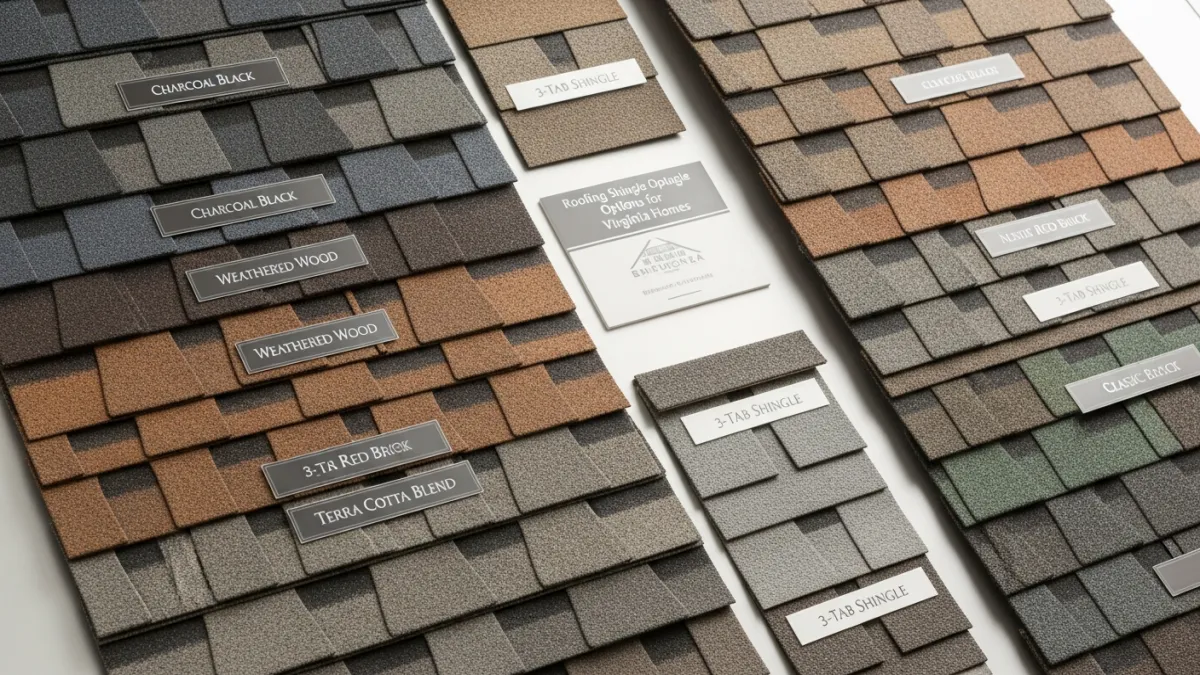
For most Northern Virginia homes, medium-toned shingles in the weathered wood, driftwood, or brownish-gray range provide the best balance of energy performance and curb appeal. These tones work with the brick, stone, and siding combinations common throughout Prince William County and complement both traditional and contemporary architectural styles. If your HOA has specific color requirements, your contractor can request samples from the manufacturer and submit them for review before placing the material order.
One practical consideration: look at shingle samples in natural outdoor light, not just under store fluorescent lighting. Colors shift dramatically between indoor showroom conditions and full sunlight. Many manufacturers offer large-format samples or even augmented reality visualization tools that show how a specific color looks on your actual home.
Installation Quality: Why It Matters as Much as the Shingle
The best shingle in the world performs poorly if installed incorrectly. Installation quality determines whether your shingle reaches its rated lifespan or fails years early. In Northern Virginia, the most common installation defects we encounter during inspections include:
- Improper nail placement: Shingles have a designated nailing zone. Nails placed too high fail to engage the underlying shingle layer, reducing wind resistance. Nails placed too low penetrate the exposed portion of the shingle below, creating a leak path
- Insufficient nails: Standard installation requires 4 nails per shingle. High-wind zones and manufacturer specifications for enhanced wind warranties often require 6 nails per shingle. Skipping nails saves the installer time but dramatically reduces wind performance
- Missing or improperly installed starter strip: Starter shingles along the eaves and rakes provide the adhesive seal for the first course of shingles. Without them, the bottom edges are vulnerable to wind uplift — the most common location for wind damage
- Inadequate valley flashing: Valleys concentrate water flow and are the highest-risk area for leaks. Proper installation requires ice-and-water shield membrane in the valley, with shingles cut and sealed according to either the closed-cut or open-metal valley method
- Missing ice-and-water shield: Virginia code requires self-adhering membrane from the eave edge to at least 24 inches past the interior wall line. This protects against ice dam leaks during winter. Skipping or shortcutting this layer creates a vulnerability that won't show up until the first significant ice event
Choosing a licensed, experienced Northern Virginia contractor with manufacturer certification is the single most effective step you can take to ensure proper installation. The difference between a five-year problem and a 25-year roof often comes down to the crew that installed it.
Need Help Choosing the Right Shingles?
We'll inspect your roof, show you product samples, and recommend the shingle that fits your home, budget, and goals. Call (571) 570-7930 or schedule online for a free consultation.
Schedule Free ConsultationFrequently Asked Questions
Conclusion
Choosing the best roofing shingles for your Virginia home comes down to matching the product to your climate, budget, and long-term plans. Architectural asphalt shingles remain the smartest choice for most homeowners in the region — they deliver strong wind resistance, algae protection, and 20-plus years of service at a price point that makes sense. If your budget allows, upgrading to impact-resistant or designer-grade products extends your roof's lifespan and can reduce insurance costs over time. Whatever you choose, proper installation by a licensed, experienced contractor and adequate attic ventilation are the non-negotiable factors that determine whether your shingles reach their full potential.
If you're planning a roof replacement or just want an honest assessment of your current shingles, Woodbridge Roofers can help. We'll inspect your roof, walk through product options, and give you a detailed estimate at no charge. Call (571) 570-7930 or book a free phone consultation to get started.