Commercial Roofing in Northern Virginia: TPO & Flat Roof Guide
Commercial Roofing in Northern Virginia: TPO & Flat Roof Guide
Key Takeaways
- Commercial roofing in Woodbridge VA typically costs $5.50 to $14.00 per square foot installed, with TPO being the most popular membrane system for Northern Virginia businesses
- TPO, EPDM, and PVC are the three primary flat roof membrane options, each with distinct advantages for different building types and budgets
- A properly maintained commercial flat roof lasts 20 to 30 years in Northern Virginia, with regular inspections extending that lifespan significantly
- Prince William County requires commercial building permits for roof replacement, and the process is more involved than residential permits. Financing options are available to help manage the investment
- Preventive maintenance programs that include biannual inspections and prompt repairs can reduce lifetime roofing costs by 30 to 50 percent compared to reactive replacement
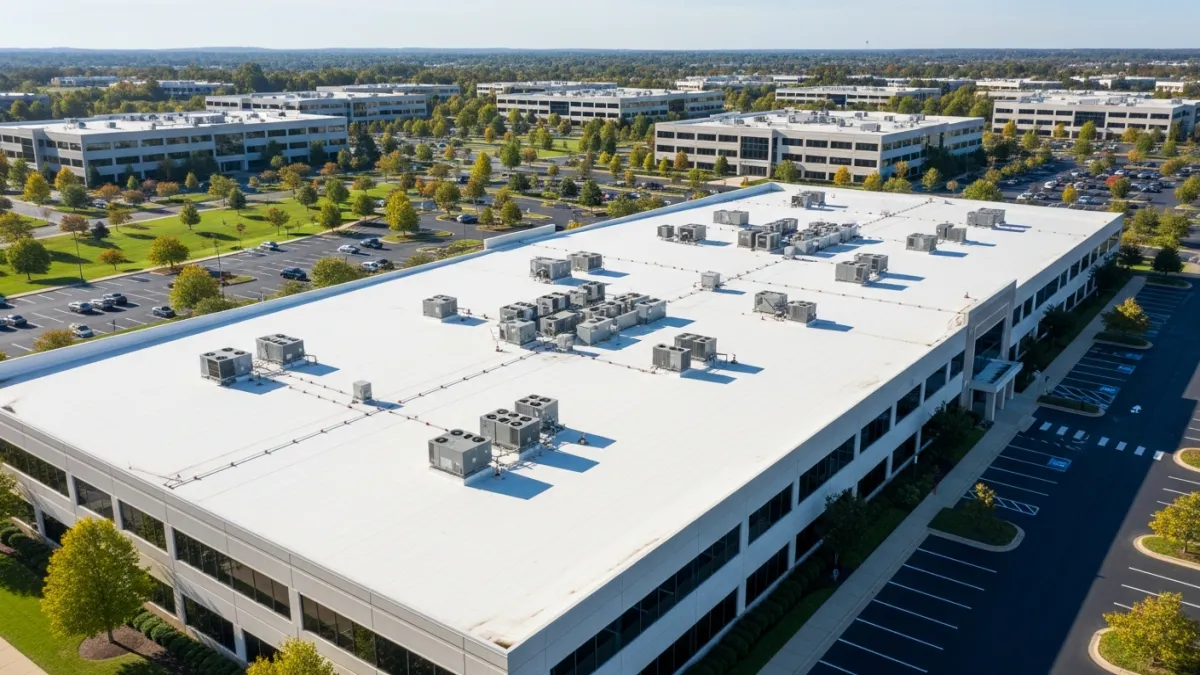
Commercial roofing in Woodbridge VA requires a fundamentally different approach than residential roofing. If you own or manage a commercial property along Route 1, in the Potomac Mills area, or anywhere in the Prince William County business corridor, your flat or low-slope roof faces unique challenges that demand specialized materials, installation techniques, and maintenance strategies. This guide covers everything you need to know about commercial roofing systems, costs, and how to choose the right contractor for your building.
Northern Virginia's commercial buildings endure the same punishing weather cycle as residential properties — summer temperatures that push rooftop surfaces past 160 degrees, winter freeze-thaw cycles that stress every seam and flashing joint, and heavy rainfall events that test drainage capacity multiple times per season. But commercial roofs have additional challenges. They're flat or nearly flat, which means water doesn't shed naturally. They support heavy HVAC equipment that creates penetration points and foot traffic wear paths. And they often cover larger areas with fewer structural supports, placing greater demands on the membrane system.
Whether you're managing a retail space near Potomac Mills, a warehouse along the I-95 corridor, an office building in the Woodbridge business district, or a restaurant in Lake Ridge, the roofing decisions you make directly impact your operating costs, tenant comfort, and property value for the next two to three decades. Energy-efficient roofing options can significantly reduce cooling costs for commercial buildings.
Why Commercial Roofing Is Different from Residential
The differences between commercial and residential roofing go far beyond scale. Understanding these distinctions helps you evaluate contractors and proposals more effectively, and it explains why a residential roofer may not be the right choice for your commercial building.
Roof Geometry and Drainage
Most residential roofs have a significant pitch — typically 4:12 to 8:12 — that uses gravity to move water toward the gutters. Commercial flat roofs have slopes of 1/4 inch per foot or less, which means water relies almost entirely on the drainage system design to leave the roof surface. Poor drainage leads to ponding water, which is the single most common cause of premature commercial roof failure. Standing water adds weight that stresses the structure, accelerates membrane deterioration, and creates leak paths at every seam and penetration it contacts.
Proper commercial roof design includes tapered insulation systems that create positive drainage slopes, strategically placed interior drains or scupper drains at the roof perimeter, and overflow drains that prevent catastrophic water accumulation if the primary system becomes blocked. In the Woodbridge area, where summer thunderstorms can drop two inches of rain in an hour, drainage capacity isn't just a maintenance issue — it's a structural safety concern.
Membrane Systems vs. Shingle Systems
Residential roofs use overlapping shingles that shed water through gravity and overlap. Commercial flat roofs use continuous membrane systems that create a monolithic waterproof barrier across the entire surface. These membranes are either heat-welded (TPO, PVC), adhered with contact cement (EPDM), or mechanically fastened to the deck. The seams in a membrane roof are its most critical feature — they must be completely watertight because there's no slope to redirect water away from a weak joint.
Insulation and Energy Performance
Commercial roofs carry their insulation above the structural deck rather than in the attic space like residential systems. This above-deck insulation — typically polyisocyanurate (polyiso) board — serves double duty as both thermal barrier and slope-creating layer. The insulation R-value required by Virginia's commercial energy code (based on IECC 2018 as adopted) is R-25 minimum for new construction, though many building owners opt for R-30 or higher to reduce long-term energy costs. Existing buildings undergoing roof replacement are generally required to bring insulation up to current code standards, which can add $1.00 to $2.50 per square foot to the project cost.
Penetrations and Equipment
Commercial roofs typically have far more penetrations than residential roofs. HVAC units, exhaust fans, plumbing vents, electrical conduits, satellite dishes, rooftop access hatches, and sometimes solar panel arrays all require flashing details that must integrate seamlessly with the membrane system. Each penetration is a potential leak source, and the flashing around rooftop equipment takes the most abuse from foot traffic during service calls. A quality commercial roofing contractor pays as much attention to penetration detailing as they do to the field membrane installation.
Commercial Roofing Materials Compared
Three membrane systems dominate the commercial flat roofing market in Northern Virginia. Each has distinct performance characteristics, cost profiles, and best-use scenarios. Understanding these differences is essential for making the right choice for your building.
TPO (Thermoplastic Polyolefin)
TPO has become the most widely installed commercial roofing membrane in the United States over the past decade, and for good reason. It offers an attractive combination of energy efficiency, durability, and competitive pricing. TPO membranes come in white, tan, and gray, with white being the most popular choice for its solar reflectance — a white TPO roof reflects up to 80 percent of solar energy, significantly reducing cooling loads during Northern Virginia's hot summers.
TPO seams are heat-welded using a hot-air gun, creating bonds that are actually stronger than the membrane itself. This is a significant advantage over adhesive-bonded systems, where seam integrity depends on the quality of the adhesive application and can degrade over time. A properly welded TPO seam will not separate under normal conditions for the life of the roof.
For Woodbridge commercial buildings, TPO performs well across all seasons. It handles the summer heat without softening or becoming brittle, maintains flexibility in winter cold, and resists the UV exposure that degrades many other membrane types. Typical TPO membrane thicknesses for commercial installations are 60 mil and 80 mil, with 60 mil being adequate for most applications and 80 mil recommended for roofs with heavy foot traffic or equipment loads.
EPDM (Ethylene Propylene Diene Monomer)
EPDM is the veteran of commercial roofing membranes, with installations dating back to the 1960s that are still in service. This synthetic rubber membrane has the longest proven track record of any single-ply system. It's available in black and white, with black being the traditional choice and white gaining popularity for its reflective properties.
EPDM's primary advantage is its exceptional flexibility and resistance to thermal cycling. It stretches and contracts with temperature changes without cracking or splitting, making it well-suited to Northern Virginia's wide temperature swings between summer and winter. The material remains flexible down to minus 40 degrees Fahrenheit, which means even the coldest Virginia winter won't make it brittle.
The main drawback of EPDM is its seam technology. EPDM seams use adhesive tape or liquid adhesive rather than heat welding, which means the seam bond is not as inherently strong as TPO or PVC. Seam failures are the most common source of leaks in aging EPDM systems. However, a quality installation with proper surface preparation and pressure rolling produces seams that hold reliably for 15 to 20 years before needing attention.
PVC (Polyvinyl Chloride)
PVC membranes share TPO's heat-welded seam technology but add superior chemical resistance. This makes PVC the top choice for restaurants, commercial kitchens, manufacturing facilities, and any building where grease, oils, or chemical fumes are exhausted through the roof. Animal fats from kitchen exhaust will destroy TPO and EPDM membranes over time, but PVC resists these substances without degradation.
PVC is also the most fire-resistant single-ply membrane, with inherent flame-retardant properties that don't require additives. For buildings along the Route 1 commercial corridor in Woodbridge where restaurants and food service businesses are common, PVC eliminates the risk of grease exhaust damaging the roof membrane.
The trade-off is cost. PVC typically runs 20 to 30 percent more than TPO for the same square footage, and it's somewhat less flexible in extreme cold. However, for the right application, the chemical resistance and fire performance justify the premium.
Metal Panel Roofing for Commercial Buildings
While flat membrane systems dominate the commercial market, standing seam metal panels are an excellent option for commercial buildings with sloped roof sections, canopy structures, or architectural features that benefit from metal's longevity and appearance. Metal panel systems last 40 to 60 years, shed water and snow efficiently, and are available in a wide range of colors and profiles that complement modern commercial architecture.
Many Woodbridge commercial buildings combine membrane systems on the flat sections with metal panels on sloped areas, parapet caps, or entrance canopies. This hybrid approach uses each material where it performs best while maintaining a cohesive building appearance.
| Material | Cost Per Sq Ft | Lifespan | Best For |
|---|---|---|---|
| TPO (60 mil) | $5.50 – $9.00 | 20 – 25 years | Office, retail, warehouse |
| EPDM (60 mil) | $5.00 – $8.00 | 25 – 30 years | Low-traffic, budget-conscious |
| PVC (60 mil) | $7.00 – $11.00 | 20 – 30 years | Restaurants, chemical exposure |
| Standing Seam Metal | $10.00 – $14.00 | 40 – 60 years | Sloped sections, long-term |
Commercial Roofing Costs in Northern Virginia
Commercial roofing costs in the Woodbridge and Northern Virginia market run 15 to 25 percent above national averages. This premium reflects higher labor rates in the DC metro area, Prince William County permit requirements, material logistics costs, and the specialized equipment needed for commercial installations. Understanding the full cost picture helps you budget accurately and evaluate contractor proposals on equal terms.
| Service / Item | Low End | High End | Notes |
|---|---|---|---|
| TPO Roof, 5,000 sq ft | $27,500 | $45,000 | 60 mil membrane, full system |
| EPDM Roof, 5,000 sq ft | $25,000 | $40,000 | 60 mil, adhered or mechanically attached |
| PVC Roof, 5,000 sq ft | $35,000 | $55,000 | Best for restaurants, chemical exposure |
| Insulation Upgrade (polyiso) | $5,000 | $12,500 | Per 5,000 sq ft, code compliance |
| Tear-Off and Disposal | $3,000 | $8,000 | Per 5,000 sq ft, single layer |
| Commercial Permit — Prince William Co. | $200 | $800 | Based on project value |
| Rooftop HVAC Curb Flashing | $300 | $800 | Per unit, custom fabricated |
Prices shown are typical ranges for Northern Virginia as of 2025 and vary based on building size, material grade, roof access, number of penetrations, and current material costs. Contact us for a free on-site estimate.
Factors That Affect Commercial Roofing Costs
Several variables move your commercial roofing project from the low end to the high end of the cost range:
- Roof size: Larger roofs benefit from economies of scale — the per-square-foot cost drops as the total area increases because fixed mobilization and equipment costs are spread across more square footage
- Membrane thickness: Upgrading from 60 mil to 80 mil TPO or EPDM adds $0.50 to $1.00 per square foot but significantly improves puncture resistance and longevity
- Number of penetrations: Each HVAC unit, exhaust fan, drain, and pipe requires individual flashing work that adds labor and material cost
- Insulation requirements: Buildings with no existing insulation or insulation below current code minimums need a full insulation package, which can add $1.00 to $2.50 per square foot
- Access and height: Multi-story buildings require boom lifts and cranes to stage materials, adding equipment rental costs
- Existing layers: Removing multiple existing roof layers before installation increases tear-off labor and disposal costs
- Drainage modifications: Adding or relocating drains, scuppers, or tapered insulation to correct ponding issues adds to the scope
What Is NOT Included in Most Commercial Roofing Quotes
Be aware of items that are typically excluded from standard commercial roofing proposals and billed separately:
- Structural deck repairs or replacement (rotted or damaged decking discovered during tear-off)
- HVAC disconnection and reconnection during roof work
- Electrical work for rooftop equipment
- Interior damage repairs from pre-existing leaks
- Crane or boom lift rental for multi-story buildings
- After-hours or weekend work to minimize business disruption
The Commercial Roof Replacement Process
Commercial roof replacement follows a structured process that differs from residential projects in scale, duration, and complexity. Here's what to expect at each stage.
Building Assessment and Core Cuts
Before providing a proposal, your contractor performs a thorough assessment that includes a visual inspection of the entire roof surface, measurement of the existing insulation R-value, evaluation of drainage patterns and ponding areas, documentation of all penetrations and equipment, and — critically — core cuts. Core cuts involve removing small cylindrical samples from the roof assembly to examine every layer from membrane through insulation to the structural deck. This reveals hidden moisture saturation, insulation degradation, and deck condition that surface inspection alone cannot detect.
For Woodbridge commercial buildings, the core cut results often determine whether a full tear-off is necessary or whether a recover (installing new membrane over the existing system) is a viable option. Virginia building code limits roofing assemblies to two layers, so if you already have two layers, tear-off is mandatory regardless of the existing system's condition.
Project Planning and Phasing
Unlike residential projects that complete the entire roof in one to three days, large commercial roofs are often completed in phases. A 20,000 square foot retail building might be divided into four 5,000 square foot sections, with each section being torn off, insulated, and covered in membrane before the crew moves to the next section. This phased approach minimizes the amount of exposed deck at any time, reducing the risk from unexpected weather and allowing the business to continue operating throughout the project.
Your contractor should provide a detailed project schedule that accounts for material delivery timing, weather windows, any required building shutdowns, and coordination with your HVAC contractor if equipment needs to be disconnected during work in specific areas.
Installation and Quality Control
Commercial membrane installation demands precision at every step. The structural deck is inspected and repaired. Cover board is installed over the deck to create a smooth substrate. Polyiso insulation boards are mechanically fastened in a staggered pattern, with tapered sections creating positive drainage slopes toward the drains. The membrane is then rolled out, positioned, and either mechanically attached, fully adhered, or a combination of both depending on wind uplift requirements for your building's height and location.
Seam welding is the most critical phase of membrane installation. For TPO and PVC systems, each seam is welded using a robot welder for field seams and a hand-held welder for detail areas around penetrations and perimeter flashing. Weld quality is verified with probing tools that confirm the seam is continuous and properly bonded. A single missed section or cold weld can become a leak source within months.
After installation, a thorough quality inspection checks every seam, every flashing detail, every drain connection, and every perimeter termination. Many commercial roofing warranties require the manufacturer to send an inspector for a final sign-off before the warranty is issued. This third-party verification is one of the strongest quality assurance measures available in commercial roofing.
Commercial Roof Maintenance in Northern Virginia
The single most effective way to maximize your commercial roof's lifespan is a structured preventive maintenance program. Commercial roofs that receive biannual inspections and prompt repairs routinely last 25 to 30 percent longer than roofs that only get attention when a leak appears. Over the life of a commercial roof, this translates to hundreds of thousands of dollars in deferred replacement costs for large buildings.
Biannual Inspection Schedule
Schedule inspections twice per year — once in spring after the freeze-thaw season ends and once in fall before winter weather begins. Spring inspections catch damage from winter ice, snow loads, and freeze-thaw cycling. Fall inspections ensure the system is tight before the next winter. Additionally, schedule an inspection after any severe weather event — thunderstorms with wind gusts above 60 mph, hail, or heavy snow loads.
During each inspection, your roofing contractor examines the membrane surface for punctures, tears, blisters, and UV degradation. They probe every seam for adhesion. They inspect all flashing details at penetrations, walls, and perimeter edges. They check drain function by running water to verify it flows properly. And they document everything with photos and a written report that tracks the roof's condition over time.
Common Maintenance Issues for Woodbridge Commercial Roofs
Northern Virginia's climate creates specific maintenance challenges for commercial flat roofs:
- Ponding water: Drain blockage from leaves and debris — particularly from the mature trees throughout the Woodbridge area — is the most common cause of ponding. Clean drains and gutters quarterly at minimum
- Seam separation: Thermal cycling stresses adhesive-bonded EPDM seams over time. Heat-welded TPO and PVC seams are more resistant but still require periodic inspection
- Flashing failures at HVAC curbs: HVAC vibration and service traffic deteriorate the flashing around rooftop units faster than field membrane. Budget for flashing repairs every 8 to 12 years
- Membrane punctures: Dropped tools, heavy equipment, and construction debris from adjacent buildings can puncture the membrane. Restrict rooftop access to authorized personnel only
- Biological growth: North-facing areas and shaded sections develop algae and moss that hold moisture against the membrane surface. Clean these areas during routine maintenance
Choosing a Commercial Roofing Contractor in Woodbridge
Selecting the right contractor for a commercial roofing project requires more due diligence than choosing a residential roofer. The stakes are higher — a poorly installed commercial roof affects your business operations, your tenants, your inventory, and your property value. Here's what to verify before signing any contract.
Licensing and Insurance Requirements
Virginia requires a Class A contractor license for commercial roofing projects exceeding $120,000 and a Class B license for projects between $10,000 and $120,000. Verify your contractor's license through the Virginia Department of Professional and Occupational Regulation (DPOR) database. In addition to the contractor license, confirm they carry general liability insurance with at least $1 million per occurrence, workers' compensation coverage for all employees, and a surety bond as required by the project size.
Manufacturer Certifications
The most meaningful quality indicator for a commercial roofing contractor is whether they hold manufacturer certification from the membrane system they're proposing. TPO, EPDM, and PVC manufacturers — including Carlisle, Firestone, GAF, Johns Manville, and Versico — all offer certified contractor programs that require documented training, minimum experience thresholds, and quality control standards. Certified contractors can offer manufacturer-backed warranties that cover both materials and workmanship, typically for 15 to 20 years. Non-certified contractors can only offer material warranties, leaving you exposed to workmanship failures.
Commercial Experience and References
Ask for references specifically from commercial projects of similar size and scope to yours. A contractor with an excellent residential track record may lack the equipment, crew size, and project management experience for a large commercial installation. Request at least three commercial references from the past two years, and follow up with those building owners or property managers to discuss the contractor's communication, timeline adherence, cleanup, and warranty responsiveness.
Commercial Roof Coatings as an Alternative
For commercial roofs that are aging but not yet failing, elastomeric roof coatings offer a cost-effective alternative to full replacement. A silicone or acrylic coating applied over an existing membrane in good condition can extend the roof's life by 10 to 15 years at roughly one-third the cost of full replacement. This approach works well for buildings where the membrane and insulation are structurally sound but the surface is showing UV degradation, minor cracking, or reduced reflectivity.
Coatings are not a solution for roofs with widespread seam failures, saturated insulation, or structural deck issues. A core-cut assessment determines whether your roof is a candidate for coating restoration or needs full replacement. For buildings along Route 1 or in the Potomac Mills commercial area where minimizing business disruption is a priority, coatings can be applied in sections without tearing off the existing system, allowing the business to operate normally throughout the project.
Energy Efficiency and Commercial Roofing
Commercial roof energy performance directly affects your bottom line every month. A white TPO or PVC membrane combined with adequate insulation can reduce cooling costs by 15 to 25 percent compared to a dark, poorly insulated roof. For a Woodbridge commercial building spending $3,000 to $5,000 per month on summer cooling, that translates to $450 to $1,250 per month in savings — money that compounds over the 20 to 30 year life of the roof.
When evaluating commercial roofing proposals, look beyond the installed cost and calculate the total cost of ownership. A TPO roof that costs $5,000 more than an EPDM system but saves $500 per month in cooling costs pays for the difference in ten months. Factor in the financing options available and the energy savings often make the higher-performance system the better financial decision from day one.
Commercial Roofing and Insurance Claims
Commercial property insurance covers roof damage from sudden, covered events — windstorms, hail, fallen trees, and fire. It does not cover damage from age, wear and tear, or deferred maintenance. The claims process for commercial properties follows the same general structure as residential claims but involves larger dollar amounts, more detailed documentation, and often longer adjustment timelines.
If your commercial roof sustains storm damage, take these steps immediately: document the damage with photos and video, prevent additional damage by covering openings with tarps, contact your insurance company to file a claim, and schedule an inspection with your commercial roofing contractor. Having your contractor present during the adjuster's inspection is critical — adjusters often miss concealed damage to insulation and flashing that only an experienced roofer would identify. Your contractor can provide a detailed scope and estimate that ensures the claim covers the full extent of the damage.
Commercial Roofing Warranties Explained
Commercial roofing warranties are more complex than residential warranties and vary significantly between manufacturers and warranty levels. Understanding the differences protects your investment and sets realistic expectations for long-term coverage.
Material-Only vs. Full System Warranties
A material-only warranty covers manufacturing defects in the membrane itself but excludes workmanship, flashing, and accessories. If a seam fails due to improper welding, a material-only warranty won't cover the repair. Full system warranties — also called NDL (No Dollar Limit) warranties — cover the entire roofing assembly including membrane, flashing, insulation, and workmanship. NDL warranties are only available through manufacturer-certified contractors and typically require a factory inspection of the completed installation.
Warranty Duration and Transfer
Standard commercial roofing warranties range from 10 to 30 years depending on the manufacturer and warranty level purchased. Most commercial warranties are transferable to new building owners, which adds value if you sell the property during the warranty period. However, some manufacturers charge a transfer fee or require notification within a specified period after the sale. Review the warranty terms carefully with your contractor before making your final decision.
Need a Commercial Roofing Estimate?
Our team handles commercial TPO, EPDM, PVC, and metal roof installations throughout Woodbridge and Northern Virginia. Call us at (571) 570-7930 for a free on-site assessment of your commercial building.
Schedule Free ConsultationFrequently Asked Questions
Conclusion
Commercial roofing in Woodbridge VA demands specialized knowledge, materials, and installation techniques that go beyond what residential roofing requires. Whether you're managing a retail center near Potomac Mills, a warehouse along the I-95 corridor, or an office complex in the Prince William County business district, choosing the right membrane system, contractor, and maintenance program directly determines how long your roof performs and how much it costs over its lifetime. TPO, EPDM, and PVC each have clear advantages for specific building types, and the right choice depends on your budget, your building's use, and your long-term ownership plans.
If your commercial roof is showing signs of age, developing leaks, or approaching the end of its warranty period, don't wait for a catastrophic failure to act. Call Woodbridge Roofers at (571) 570-7930 or schedule a free consultation to get a professional assessment and detailed proposal for your building.