Gutter Installation and Repair in Woodbridge VA
Gutter Installation and Repair in Woodbridge VA
Key Takeaways
- Seamless aluminum gutters are the standard for gutter installation in Woodbridge VA, costing $1,200 to $3,500 installed on a typical home
- Properly functioning gutters protect your foundation, fascia, siding, and landscaping from water damage that costs thousands to repair
- Woodbridge receives approximately 42 inches of rainfall per year — adequate gutter capacity is essential for managing that volume
- Gutter guards reduce cleaning frequency and prevent overflow damage, paying for themselves within 5 to 8 years for most homes
- Replacing gutters during a roof replacement saves on labor costs and ensures proper drip edge integration
Gutter installation in Woodbridge VA is one of the most important investments you can make to protect your home's foundation, fascia, and landscaping. Properly sized seamless aluminum gutters channel rainwater away from your structure, preventing the soil erosion, basement moisture, and foundation settling that affect thousands of Northern Virginia homes every year. The typical cost is $1,200 to $3,500 installed, depending on home size and configuration.
Gutters don't get the attention that roofing shingles or siding receives during home improvement planning, but they do some of the hardest work on your exterior. Every rainstorm that hits Woodbridge sends hundreds of gallons of water cascading off your roof. Without gutters — or with gutters that are damaged, clogged, or improperly pitched — that water falls directly against your foundation, pools around your basement walls, saturates the soil beside your home, and splashes back against your siding. Over months and years, the damage compounds in ways that are expensive to fix and largely preventable.
This guide covers everything Woodbridge homeowners need to know about gutters: types, sizing, installation, repair, gutter guard options, costs, and when to replace versus repair. Whether you're building new, replacing aging gutters, or dealing with drainage problems on your existing system, you'll find the practical information you need to make a confident decision.
Why Gutters Matter in Woodbridge VA
Woodbridge sits in the Potomac River watershed and receives an average of approximately 42 inches of rainfall per year. Summer thunderstorms can dump an inch or more in under an hour. Tropical storm remnants periodically bring multi-day rain events that saturate the clay-heavy soils common throughout Prince William County. This combination of volume and intensity makes gutter performance critical.
Foundation Protection
The primary job of your gutter system is directing water away from your foundation. Without functional gutters, water cascading off the roof edge lands within 12 to 18 inches of your foundation wall. On homes throughout the Woodbridge and Dale City area, where many foundations sit on the expansive clay soils that characterize the Northern Virginia Piedmont, this concentrated water causes the soil to swell when saturated and shrink when dry. Over time, this cycle creates uneven pressure against the foundation wall, leading to cracks, bowing, and moisture intrusion into basements and crawl spaces.
Foundation repair in Northern Virginia typically costs $5,000 to $15,000 or more, depending on the severity. A properly installed gutter system costing $1,500 to $3,500 prevents the conditions that cause the majority of foundation water problems. The math is clear.
Fascia and Soffit Protection
When gutters clog and overflow, water runs behind the gutter and against the fascia board — the wooden trim piece that the gutter attaches to. Prolonged moisture contact causes the fascia to rot, which weakens the gutter mounting and allows more water to reach the soffit and roof edge. Homes along Smoketown Road, throughout the Cardinal Forest neighborhood in Dale City, and in the established sections of Lake Ridge frequently show fascia damage from years of gutter overflow. Replacing rotted fascia typically costs $15 to $25 per linear foot — another expense that proper gutter maintenance prevents.
Landscaping and Erosion Control
Water dumping off an unguttered roof edge erodes mulch beds, damages plantings, creates trenches along the foundation perimeter, and splatters mud onto siding. In neighborhoods with graded lots and downhill neighbors — common in the rolling terrain of Montclair, Old Bridge Estates, and the Potomac Mills area — uncontrolled roof runoff can also create drainage disputes with adjacent properties. Gutters with properly extended downspouts direct this water to safe discharge points at least four to six feet from the foundation.
Types of Gutters for Woodbridge Homes
Not all gutters are created equal. Here's a breakdown of the options available to Northern Virginia homeowners, with honest assessments of each.
Seamless Aluminum Gutters
Seamless aluminum gutters are the standard for residential homes in Virginia and represent roughly 90 percent of all new gutter installations in the Woodbridge market. They're formed on-site from continuous coils of aluminum using a portable gutter machine, producing a single piece that runs the entire length of each section without joints or seams. This is important because seams are the most common failure point on older gutters — they separate over time, creating leaks that dump water against the fascia and foundation.
Aluminum gutters are lightweight, corrosion-resistant, available in dozens of factory-applied colors, and priced within reach of most budgets. The standard residential size is 5-inch K-style (named for its profile shape), which handles the rainfall volume on most Woodbridge homes adequately. For homes with large roof areas or steep pitches that concentrate heavy water flow, 6-inch K-style gutters provide approximately 40 percent more capacity.
Copper Gutters
Copper gutters are the premium option for homes where aesthetics and longevity are the top priorities. They develop a distinctive patina over time and can last 50 years or more with minimal maintenance. The cost is substantial — $25 to $45 per linear foot installed, roughly three to four times the price of aluminum. Copper gutters make the most sense on high-value homes with architectural details that complement the material, such as the custom homes in Belmont Bay, River Falls, and the waterfront properties near Occoquan.
Steel Gutters
Galvanized steel gutters are heavier and stronger than aluminum, making them suitable for areas with heavy snow load or frequent ladder placement. However, they are prone to rust over time, especially at scratches and cut edges where the galvanized coating is compromised. Stainless steel eliminates the rust issue but at a cost comparable to copper. Steel gutters represent a small fraction of the Woodbridge market — aluminum outperforms them on durability-per-dollar for most residential applications.
Half-Round Gutters
Half-round gutters have a semicircular profile that complements traditional, colonial, and historic home styles. They are less efficient at handling high water volume than K-style gutters of the same width because the rounded profile has less cross-sectional area. Half-round gutters are typically used on homes where architectural authenticity matters more than maximum capacity — older homes in the Occoquan historic district or period-style custom homes throughout the area.
Gutter Sizing: Getting It Right
Undersized gutters are one of the most common problems we encounter on Woodbridge homes. A gutter system that can't handle the water flow rate during heavy rain overflows, which is functionally the same as having no gutters at all during the storms that matter most.
The Sizing Calculation
Gutter sizing is based on the maximum rainfall intensity for your region and the roof area draining to each gutter section. Northern Virginia falls in a rainfall intensity zone of approximately 5.8 inches per hour for a 5-minute, 100-year storm event. This is the design basis for proper gutter sizing.
The calculation works as follows:
- Determine the roof drainage area for each gutter section (length of gutter run multiplied by the horizontal distance from the gutter to the ridge, adjusted for roof pitch)
- Apply the rainfall intensity factor for our region (5.8 inches per hour)
- Compare the required capacity to the gutter capacity: a 5-inch K-style gutter handles approximately 5,520 square feet of drainage area per downspout, while a 6-inch K-style handles approximately 7,960 square feet
For a practical example: if your home has a 40-foot gutter run with a 20-foot horizontal rafter length on a 6:12 pitch roof, the adjusted drainage area is approximately 896 square feet. A 5-inch gutter with one downspout handles this comfortably. But if that same run collects from a steeper roof or a larger area — common on two-story colonial homes throughout Woodbridge — the calculation may push into 6-inch territory. Your contractor should run these numbers for each gutter section, not just guess based on what's most common.
Downspout Spacing and Sizing
Downspouts are the drainage pathway from the gutter to the ground. Proper downspout sizing and spacing is as important as the gutter itself. General rules for Northern Virginia installations:
- One downspout for every 35 to 40 feet of gutter run
- Standard 2x3-inch rectangular downspouts pair with 5-inch gutters
- 3x4-inch rectangular downspouts pair with 6-inch gutters
- Downspouts should discharge at least 4 to 6 feet from the foundation — underground extensions to a pop-up emitter or dry well are ideal on homes with grading challenges
- Never connect downspouts to the sewer system or allow them to discharge onto neighboring property
Gutter Installation Process
Understanding what happens during a professional gutter installation helps you evaluate contractors and prepare for the work.
Step 1: Measurement and Assessment
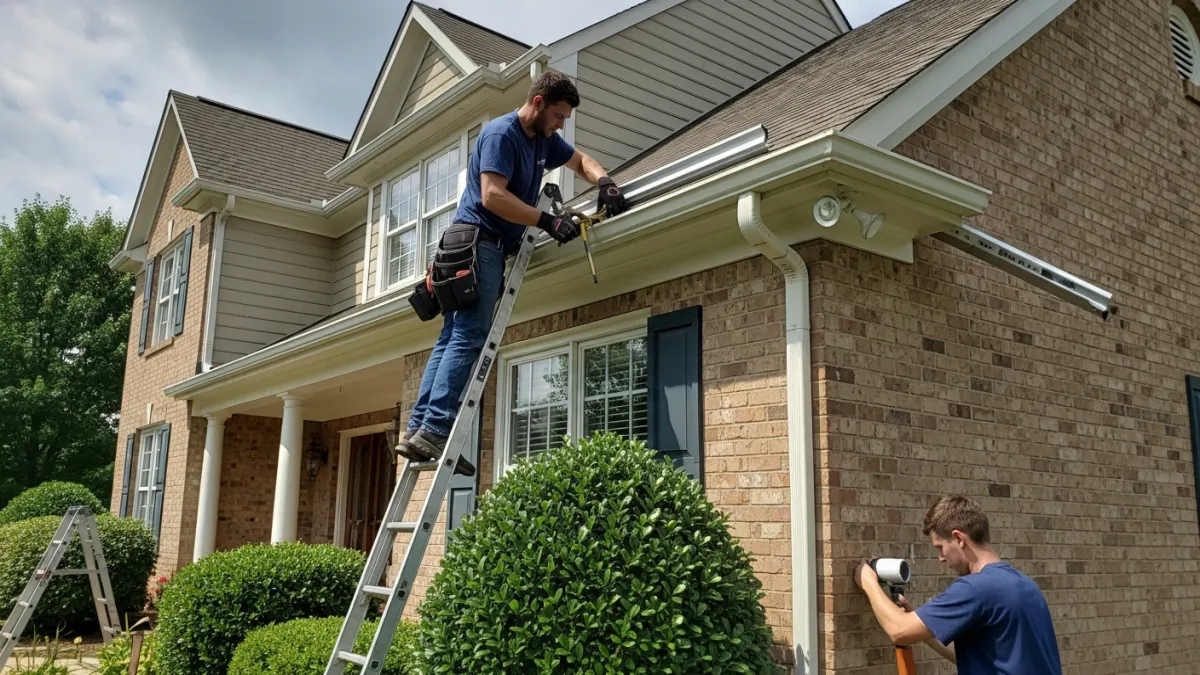
Your contractor measures every gutter run, identifies downspout locations, evaluates the fascia board condition, and notes any obstacles such as utility connections, light fixtures, or landscape features that affect installation. The fascia board must be solid — gutter screws driven into rotted wood will pull out under the weight of water-filled gutters. Any compromised fascia sections are flagged for replacement before gutter installation begins.
Step 2: On-Site Fabrication
Seamless gutters are formed on-site using a portable roll-forming machine mounted in a trailer. The machine feeds flat aluminum coil stock through a series of rollers that shape it into the K-style profile. Each piece is cut to the exact length of its intended run, eliminating mid-run seams. The only joints in a seamless system are at inside corners, outside corners, and end caps — each sealed with gutter sealant.
Step 3: Mounting and Pitch
Gutters must be installed with a slight downward pitch toward each downspout — typically a quarter inch of drop per 10 feet of run. This pitch is subtle enough that it's not visible from the ground but critical for ensuring water flows to the downspouts rather than standing in the gutter. Standing water breeds mosquitoes, accelerates corrosion, and adds weight that stresses the hangers.
Professional installation uses hidden hangers spaced every 24 to 32 inches, screwed through the gutter and into the fascia board. This is significantly stronger than the spike-and-ferrule system used on older homes, where nails driven through the front of the gutter tend to pull loose over time from thermal expansion and ice weight.
Step 4: Downspout Installation and Drainage
Downspouts are attached with screws and outlet tubes cut into the gutter at calculated positions. Extensions at the base direct water away from the foundation. On homes where space is tight or grading directs water back toward the house, underground downspout extensions connect the downspout to a buried pipe that carries water to a pop-up emitter, dry well, or daylight outlet further from the structure. This underground approach is especially valuable on the sloped lots common in Montclair, Lake Ridge, and the areas along Minnieville Road.
Common Gutter Problems in Woodbridge
These are the gutter issues we see most frequently on Woodbridge homes, along with the appropriate repair or replacement approach for each.
Clogging
Clogged gutters are the number one problem in our area. The mature oaks, sweetgums, maples, and pines throughout Woodbridge neighborhoods drop leaves, seed pods, pine needles, and pollen into gutters from spring through late fall. When debris accumulates, water backs up, overflows, and runs down the fascia and foundation. In winter, trapped water freezes and expands, which can crack aluminum gutters or pull hangers out of the fascia.
The solution is regular cleaning — twice per year minimum — or gutter guard installation for long-term prevention.
Sagging and Pulling Away
Gutters that sag or pull away from the fascia are typically suffering from one of three issues: rotted fascia that can no longer hold screws, inadequate hanger spacing, or ice damage from frozen clogs. The fix depends on the cause. Rotted fascia requires board replacement before re-mounting. Inadequate hangers can be supplemented with additional fasteners. Ice-damaged sections may need straightening or replacement.
Leaking Seams and Joints
Older sectional gutters develop leaks at the seams where pieces were joined together. Sealant deteriorates over time, and thermal expansion and contraction works the joints apart. Minor leaks can be resealed with gutter-specific sealant, but if the leaking is widespread across multiple joints, replacing the system with seamless gutters is more cost-effective than ongoing repair.
Improper Pitch
Gutters installed without adequate slope — or gutters that have shifted over time due to settling, fascia deterioration, or thermal movement — develop standing water sections. You can identify this problem after a rainstorm by looking for water remaining in the gutters after surrounding sections have drained. Re-pitching the affected section usually involves loosening the hangers, adjusting the slope, and re-securing.
Gutter Guards: Types and Effectiveness
Gutter guards reduce maintenance and prevent overflow damage by keeping debris out of the gutter channel. Not all gutter guards are created equal, and the right choice depends on the type of trees near your home and your budget.
Micro-Mesh Guards
Micro-mesh guards use a fine stainless steel screen over a rigid frame to block even small debris like pine needles and roof granules while allowing water to flow through. These are the most effective type for Northern Virginia homes and the option we recommend most frequently. Professional-grade micro-mesh systems cost $15 to $25 per linear foot installed and virtually eliminate the need for routine gutter cleaning. They do require occasional surface brushing to remove accumulated pollen or roof debris from the mesh surface, but this is far less labor than cleaning out packed gutters twice a year.
Reverse-Curve (Surface Tension) Guards
These guards use a curved surface that allows water to follow the curve into the gutter while debris slides off the edge. They work reasonably well with large leaves but are less effective with small debris like pine needles, shingle granules, and seed pods. In heavy rain, water can overshoot the curve and miss the gutter entirely. Surface tension guards are visible from the ground, which some homeowners and HOAs find objectionable.
Screen and Foam Inserts
Budget screen guards and foam inserts sold at home improvement stores cost $1 to $5 per linear foot but provide limited long-term protection. Screen guards allow small debris through and can collapse under snow load. Foam inserts trap debris within the foam itself, creating a clog inside the guard that's harder to clean than an open gutter. We generally don't recommend these products for permanent installations — the initial savings is offset by ongoing problems within two to three years.
Gutter Cost in Woodbridge VA
Here's what gutter installation costs in the Woodbridge area for different configurations. Northern Virginia prices run 15 to 20 percent above national averages. These figures include materials, labor, and standard downspout configuration.
| Service / Item | Low End | High End | Notes |
|---|---|---|---|
| 5-inch seamless aluminum gutters | $8/ft | $15/ft | Standard residential, most common |
| 6-inch seamless aluminum gutters | $10/ft | $19/ft | High-volume or steep-pitch roofs |
| Copper gutters | $25/ft | $45/ft | Premium, 50+ year lifespan |
| Whole-home gutter replacement (150-200 ft) | $1,200 | $3,500 | Aluminum, includes downspouts |
| Micro-mesh gutter guards | $15/ft | $25/ft | Professional-grade, most effective |
| Gutter guards whole-home (150-200 ft) | $1,500 | $4,000 | Micro-mesh, professional install |
| Gutter cleaning (per visit) | $150 | $300 | 2-story home, twice per year |
| Fascia board replacement | $15/ft | $25/ft | Required if rotted from overflow |
| Underground downspout extension | $300 | $800 | Per downspout, with pop-up emitter |
Prices shown are typical ranges for Northern Virginia as of 2025 and vary based on home size, accessibility, stories, and current material costs. Contact us for a free on-site estimate.
The most reliable way to know what your gutter project will cost is to schedule a measurement. We provide detailed estimates at no charge. Book a free consultation and we'll walk through the options for your home.
When to Repair vs. Replace Your Gutters
Not every gutter problem requires full replacement. Here's a practical decision framework for Woodbridge homeowners.
Repair Makes Sense When
- The problem is isolated to one or two sections (a leaking joint, a dislodged hanger, a damaged downspout)
- The gutters are less than 15 years old and in generally good condition
- The issue is a maintenance problem (clogging) rather than a structural problem (sagging, separation)
- Re-pitching or re-securing can restore proper function
Replacement Makes Sense When
- Multiple seams are leaking across the system (common on older sectional gutters)
- The gutters are pulling away from the fascia in multiple locations due to deteriorated mounting
- Significant corrosion, pitting, or holes are present
- The gutters are undersized for your roof and chronic overflow occurs during moderate rain
- You're replacing your roof — this is the most cost-effective time to add new gutters
- The existing gutters are 20+ years old and approaching the end of their service life
Gutters and Roof Replacement: The Connection
If you're planning a roof replacement, this is the ideal time to address your gutters as well. Here's why the two projects pair so effectively.
During a roof replacement, the crew installs new drip edge along the eaves and rakes. Drip edge is the metal flashing strip that directs water off the roof edge and into the gutter. New drip edge integrates cleanly with new gutters, ensuring a watertight connection between the roof system and the drainage system. Installing new gutters after a roof replacement — even months later — means the contractor may need to adjust or bend the drip edge to accommodate the new gutter profile, which is workable but less ideal.
The labor savings are real. The roofing crew already has ladders, scaffolding, and equipment in place. Adding gutter removal and installation to the project scope costs less than scheduling a separate gutter project later because the mobilization, setup, and access costs are already absorbed by the roofing contract. For more details on how we coordinate these projects, see our roof replacement process guide.
Gutter Maintenance Schedule for Woodbridge Homes
Even the best gutter system requires periodic maintenance. Here's a realistic maintenance schedule for homes in the Woodbridge area.
- Late spring (May): Clean gutters after seed pod and pollen season. Check for winter damage including cracked sections, displaced hangers, and ice-related deformation
- Late fall (November-December): Clean gutters after leaf drop is substantially complete. This is the most critical cleaning because leaves left in gutters over winter become saturated, freeze, and create ice dams that damage both the gutters and the roof edge
- After major storms: Walk the perimeter and visually check for debris accumulation, displaced downspouts, or overflow staining on the fascia. Heavy storms can deposit enough debris to clog a section in a single event
- Annual inspection: Check hanger tightness, seam integrity, downspout connections, and discharge point drainage. Confirm that extensions are directing water at least 4 to 6 feet from the foundation
If you'd rather not handle gutter maintenance yourself, professional cleaning services in the Woodbridge area typically charge $150 to $300 per visit for a two-story home. Two cleanings per year runs $300 to $600 annually. Compare that to the one-time cost of micro-mesh gutter guards ($1,500 to $4,000) to determine which approach makes more financial sense for your situation.
Need Gutter Installation or Repair?
Woodbridge Roofers installs seamless aluminum gutters, gutter guards, and underground drainage extensions throughout Prince William County. Call (571) 570-7930 for a free estimate or schedule online.
Schedule Free ConsultationFrequently Asked Questions
Conclusion
Your gutters work quietly in the background until they stop working — and then the consequences show up fast. Foundation damage, rotted fascia, eroded landscaping, and basement moisture are all problems that properly installed and maintained gutters prevent. For Woodbridge homes dealing with 42 inches of annual rainfall, heavy summer thunderstorms, and the debris from mature tree canopies across Prince William County, investing in seamless aluminum gutters with adequate sizing and professional installation is one of the most cost-effective ways to protect your home.
Whether you need a full gutter replacement, gutter guard installation, or repair to an existing system, Woodbridge Roofers handles the entire process from measurement through cleanup. Call (571) 570-7930 or book a free phone consultation to get started with a no-obligation estimate.