Gainesville VA Roofing: Prince William County Experts
Gainesville VA Roofing: Prince William County Experts
Key Takeaways
- A local roofing company in Gainesville VA understands Prince William County permits, HOA requirements in Heritage Hunt and Linton Hall, and the weather patterns that affect roof longevity along the I-66 corridor
- Architectural asphalt shingle replacements in Gainesville typically cost $8,500 to $15,500 for a 2,000 square foot home, with standing seam metal running $16,000 to $23,000
- Always verify your contractor holds a valid Virginia DPOR license and carries both general liability and workers compensation insurance
- Gainesville homes face hot summers, freeze-thaw cycles, severe thunderstorms along the I-66 corridor, and high winds near the Bull Run Mountains that demand experienced local contractors
- Local roofers respond faster to emergencies, know neighborhood-specific HOA rules, and rely on community reputation for referrals across western Prince William County
A roofing company in Gainesville VA that actually works in the community brings advantages you won't find with an out-of-area contractor or a national franchise operating from a satellite office. Gainesville sits in the western half of Prince William County along the I-66 corridor, and its homes face a specific combination of weather conditions, HOA landscapes, and construction styles that require local knowledge to handle correctly. When you're dealing with storm damage after a summer thunderstorm rolls through Heritage Hunt, or you've noticed shingle deterioration on your Linton Hall home and need an honest assessment, the contractor who knows your neighborhood and can be on site quickly is the one who delivers the best outcome.
Gainesville has grown rapidly over the past two decades, transforming from a rural crossroads along Route 29 into one of the most sought-after residential areas in Northern Virginia. Communities like Heritage Hunt, Virginia Gateway, Linton Hall, Piedmont, Clevengers Corner, and the neighborhoods near Jiffy Lube Live have brought thousands of homes that range from active-adult single-story designs to large colonial and craftsman-style properties with complex roof geometries. That growth means a wide variety of roofing challenges — from aging roofs on early-2000s construction that are now approaching the 20-year replacement window to newer homes with steep pitches and intricate flashing details that demand precision installation.
This guide covers what to look for in a Gainesville roofing company, what roofing services you should expect, how local expertise translates to better results on your specific roof, and what the project will realistically cost. Whether you need a repair, a full replacement, storm damage restoration, or a straightforward assessment of your roof's remaining lifespan, the information here puts you in a strong position to make a confident decision.
Why Local Expertise Matters for Gainesville Roofing
Roofing is one of the few home improvement categories where geographic knowledge directly affects quality. A contractor who has completed hundreds of projects in Gainesville and the surrounding western Prince William County communities brings practical experience that contractors from outside the area simply don't have. That experience shows up in material recommendations, installation techniques, and how problems are diagnosed.
Gainesville's Climate and Weather Challenges
Gainesville's position along the I-66 corridor at the base of the Bull Run Mountains creates a microclimate that's subtly different from communities further east in Prince William County. Summer temperatures push attic spaces to 140 to 160 degrees, accelerating the breakdown of asphalt binders from the underside of shingles. The elevation and open terrain along Route 29 between Gainesville and Haymarket expose roofs to higher sustained winds during storm events compared to more sheltered communities closer to the Potomac. Winter brings repeated freeze-thaw cycles that expand moisture in hairline cracks, work flashing joints apart, and create conditions for ice damming at eaves on homes with insufficient attic insulation.
Severe thunderstorms are particularly common along the I-66 corridor during late spring and summer. These storms develop rapidly over the Blue Ridge and push eastward, often bringing damaging wind gusts, hail, and heavy rain that tests every component of a roofing system simultaneously. A local roofing company has seen these conditions play out on Gainesville homes year after year and knows exactly which failure points to look for after a major weather event.
Prince William County Permit Requirements
Prince William County requires building permits for full roof replacements, and the process has specific requirements that differ from neighboring jurisdictions like Loudoun County or Fauquier County — both of which border the Gainesville area. A local contractor handles this process routinely and pulls permits efficiently without delays. They know the inspection scheduling process, the code requirements for underlayment, fastener patterns, ice-and-water shield at eaves and valleys, and ventilation standards that the county inspector will verify on your completed roof.
Permit fees in Prince William County typically range from $75 to $250 depending on the scope of work. Your contractor should include permit procurement in their scope of services. Never hire a contractor who suggests skipping the permit — unpermitted work creates problems when you sell your home, can void your insurance coverage, and may result in fines.
HOA Knowledge Across Gainesville Communities
Gainesville is dominated by planned communities with active homeowners associations, and each one has its own architectural review process for exterior modifications including roofing. Heritage Hunt — the large active-adult community off Linton Hall Road — has specific guidelines covering shingle profiles, acceptable colors, and notification timelines. Virginia Gateway near the Route 29 and I-66 interchange has its own architectural committee. Linton Hall, Piedmont, Braemar, and the communities along Heathcote Boulevard each maintain separate review processes with different documentation requirements.
A roofing company that has completed projects in these neighborhoods understands each HOA's approval timeline, required submissions, and color restrictions. Some associations require a sample board and contractor documentation before work begins. Others require written notification but don't mandate pre-approval. A few restrict material types — certain communities may not allow metal roofing or require specific architectural shingle profiles to maintain neighborhood uniformity. Your contractor should guide you through your specific HOA's process based on direct experience.
Roofing Services Every Gainesville Homeowner Needs Access To
A full-service roofing company in Gainesville VA should handle the complete range of residential roofing needs. Here's what to expect from a legitimate, established local contractor serving western Prince William County.
Roof Inspections and Honest Assessments
Every roofing project should begin with a thorough on-site inspection. This means a contractor physically examining your roof from the ground, from a ladder at multiple points, and from inside the attic. They're evaluating shingle condition on every slope, checking flashing integrity at chimneys, skylights, and wall transitions, assessing ventilation adequacy, and looking for signs of moisture damage on the underside of the roof deck. A satellite-image estimate or a phone quote based on your description is not an inspection — it's a guess.
A quality inspection takes 30 to 60 minutes and produces specific findings with clear recommendations. Your contractor should tell you exactly what they found, what it means for your roof's remaining lifespan, and whether repair or replacement is the appropriate response. Many Gainesville homes built between 2000 and 2008 are now approaching the 20-year mark — the point where a professional assessment of remaining service life becomes genuinely valuable.
Roof Repairs
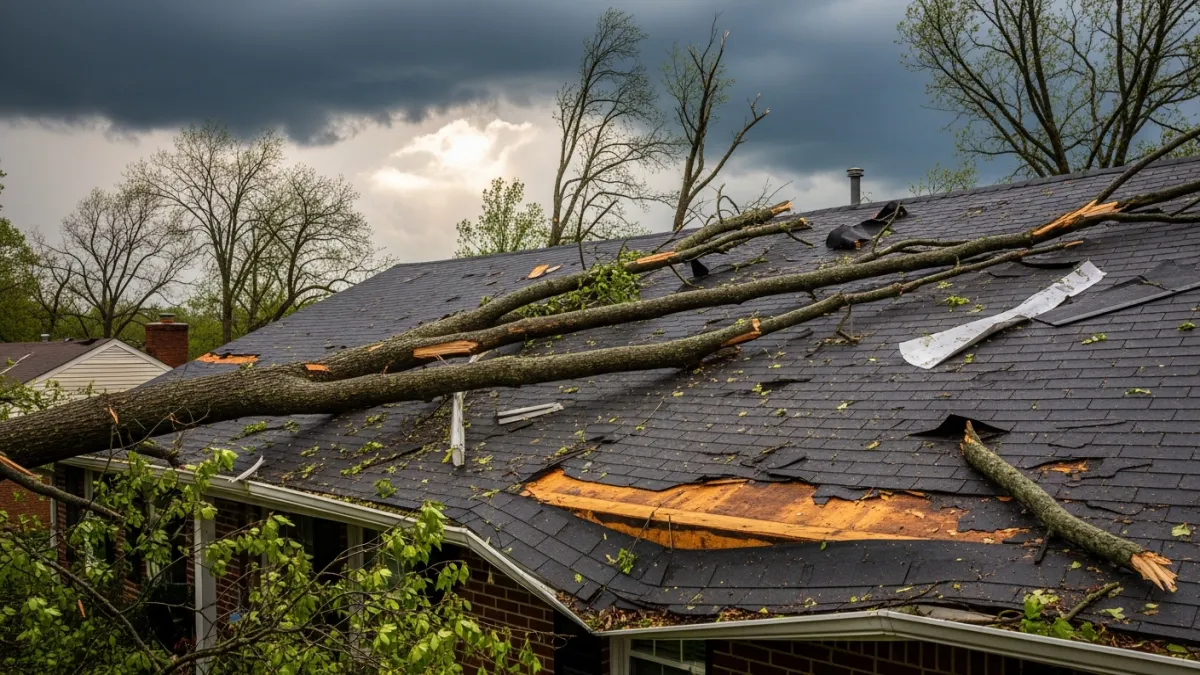
Not every roof problem requires a full replacement. A competent Gainesville roofing company should assess whether a targeted repair will resolve the issue and extend your roof's useful life. Common repairs include replacing blown-off shingles after storms along the I-66 corridor, re-sealing or replacing failed flashing at chimneys and wall transitions, fixing leaking pipe boots, patching sections damaged by fallen tree limbs — particularly common on wooded lots near the Haymarket border — and addressing localized areas of granule loss or cracking.
The distinction between repair and replacement comes down to whether the damage is isolated or systemic. If one area is damaged and the rest of the roof is in good condition, repair is almost always the right call. If the same type of problem keeps appearing in different locations across the roof, that signals system-wide aging that repairs won't solve long-term.
Full Roof Replacements
When your roof reaches the end of its functional life, a full replacement is the right investment. This involves tearing off all existing roofing materials down to the deck, inspecting and repairing the substrate, and installing a complete new roofing system from underlayment through ridge cap. For a detailed walkthrough of every step involved, see our guide on the roof replacement process.
Your roofing company should provide a detailed, itemized estimate that separates materials, labor, tear-off and disposal, permit fees, and decking replacement allowances. Vague lump-sum proposals make it impossible to compare bids fairly and suggest a contractor who either doesn't want you to see the breakdown or hasn't thought through the scope carefully enough to produce one.
Storm Damage Restoration and Insurance Claims
Gainesville's position along the I-66 corridor means it receives a significant share of severe weather events. Summer thunderstorms with damaging winds, occasional hailstorms, and the remnants of tropical systems tracking up the East Coast all pose real risks to roofing systems. When storm damage occurs, your roofing company should be experienced in documenting damage thoroughly, working with insurance adjusters, and navigating the claims process on your behalf.
A contractor who regularly handles insurance claims in western Prince William County knows how to identify all damage — including less obvious issues like bruised shingles, compromised underlayment, and displaced flashing seals — and present the documentation in a format that insurance companies accept. They should be present during the adjuster's inspection and prepared to submit supplements if the initial assessment doesn't cover the full scope of necessary work.
Flat Roof Services
Many Gainesville homes — particularly those with room additions, covered porches, or sunrooms — have flat or low-slope roof sections that require specialized membrane systems rather than standard shingles. TPO, EPDM, and modified bitumen are the most common flat roof materials, and each has specific installation requirements that differ from steep-slope shingle work. A roofing company serving Gainesville should have documented experience with flat roof systems and the ability to integrate them seamlessly with the adjacent steep-slope roof.
Gutters and Siding
Your roof, gutters, and siding function as an integrated system. When one fails, it frequently affects the others. A roofing company that also handles gutter installation, gutter repair, and siding replacement can address your entire exterior envelope in a coordinated project. This avoids the common scenario where one contractor installs a new roof and a different contractor then discovers the gutter system needs re-hanging or the fascia boards behind the gutters are rotted — creating a finger-pointing situation between two separate companies.
How to Evaluate a Roofing Company in Gainesville VA
Choosing the right contractor is one of the most consequential decisions in any roofing project. The contractor's skill, materials, and attention to detail determine whether your new roof lasts 15 years or 30 years. Here's how to evaluate your options systematically.
Verify Virginia DPOR Licensing
This is the non-negotiable starting point. Virginia law requires roofing contractors to hold a license from the Department of Professional and Occupational Regulation. The license type depends on the contract value — Class A for projects over $120,000, Class B for $10,000 to $120,000, and Class C for $1,000 to $10,000. Most residential roof replacements in Gainesville fall into the Class B range given local material and labor costs. You can verify any contractor's license status on the DPOR website in minutes. If a contractor can't provide a valid license number, end the conversation.
Confirm Insurance Coverage
Ask for certificates of both general liability insurance and workers compensation insurance. General liability protects your property if the crew causes damage during the project. Workers compensation protects you from liability if a worker is injured on your property. Don't just look at the certificate — call the insurance carrier directly to verify the policy is active. An expired or insufficient policy transfers financial risk from the contractor to you, and that risk is real on a project that involves people working at height on your home.
Get Multiple Detailed Estimates
Three estimates from qualified contractors establishes a reasonable price range and helps identify outliers. A bid dramatically below the others is almost certainly cutting corners on materials, labor, or both. A bid significantly above should come with a clear explanation of what upgrades or additional scope justify the premium. Compare estimates on an apples-to-apples basis — same material specifications, same scope of tear-off and disposal, same treatment of decking replacement. A quality contractor provides an itemized proposal that lists every component separately: shingle product and specification, underlayment type, drip edge, flashing, pipe boots, ridge vent, starter strip, hip and ridge cap, tear-off and disposal, decking allowance, permit fees, and warranty terms.
Check Local Track Record in Gainesville
Ask specifically about projects completed in Gainesville and western Prince William County. A contractor who has worked on homes in Heritage Hunt, Virginia Gateway, Linton Hall, or the neighborhoods along Route 29 understands the local dynamics — HOA processes, county inspection expectations, tree coverage patterns near the Haymarket border, and the specific roof geometries common across Gainesville's housing stock. Ask for references from recent projects and follow up on them.
Gainesville Neighborhoods and Their Roofing Challenges
Gainesville's rapid growth has created a diverse landscape of communities, each with its own set of roofing considerations. Understanding the specific challenges in your neighborhood helps you make better decisions about materials, timing, and contractor selection.
Heritage Hunt
Heritage Hunt is one of the largest active-adult communities in Prince William County, located off Linton Hall Road with homes built primarily between 2000 and 2012. Many of these properties are now approaching or have passed the 20-year mark, which means roof replacements are becoming increasingly common throughout the community. Heritage Hunt's architectural review committee maintains specific standards for shingle colors and profiles, and the community's single-story and ranch-style designs make roof access relatively straightforward compared to multi-story homes. However, the open terrain and minimal tree canopy on many Heritage Hunt lots means roofs are fully exposed to sun and wind, which accelerates aging on south-facing slopes.
Virginia Gateway
Virginia Gateway, situated near the Route 29 and I-66 interchange, is one of Gainesville's newer and more prominent mixed-use communities. The residential sections feature contemporary home designs with steeper roof pitches, multiple gable ends, and complex roof geometries that require experienced installation crews. These homes are still relatively young, but the combination of steep slopes and exposure to the wind corridor along I-66 makes them susceptible to shingle blow-offs during severe storms. Virginia Gateway's HOA has its own architectural standards, and a local contractor who has worked in the community knows the approval process and acceptable material options.
Linton Hall
The Linton Hall area encompasses several interconnected communities along Linton Hall Road, including Linton Hall Village, University Village, and the neighborhoods surrounding Patriot High School. Homes here were built across a wide timeframe — from the early 2000s through the 2010s — creating a mix of roofs at different stages of their lifespans. The rolling terrain in the Linton Hall corridor means many homes sit on slopes that create complex drainage patterns and require careful attention to valley flashing and gutter sizing. Tree coverage varies significantly from lot to lot, with some properties experiencing heavy shade that promotes algae and moss growth on north-facing slopes.
Jiffy Lube Live Area and Route 29 Corridor
The neighborhoods surrounding the Jiffy Lube Live amphitheater and along the Route 29 corridor between Gainesville and the Haymarket border include a mix of established single-family homes and newer development. Properties along this stretch face some of the highest wind exposure in the Gainesville area due to the open terrain and the natural wind funnel created by the Bull Run Mountains to the west. Homes here benefit from impact-rated shingles with enhanced wind warranties and properly installed starter strips along eaves and rakes. A roofing company familiar with this corridor understands that standard wind-rated products may not be sufficient for the most exposed lots.
I-66 Corridor and Haymarket Border
The I-66 corridor forms the spine of western Prince William County, and homes along both sides of the interstate — from the Gainesville interchange westward toward Haymarket — experience the full spectrum of Northern Virginia weather events at higher intensity than more sheltered communities to the east. The transition zone between Gainesville and Haymarket includes neighborhoods like Piedmont, Clevengers Corner, and the communities off Heathcote Boulevard. These areas feature larger lots with more tree coverage than the newer Gainesville communities, which creates different challenges: increased debris accumulation in valleys and gutters, shade-induced algae growth, and occasional limb damage during storms.
Roofing Materials for Gainesville VA Homes
The material you choose determines your roof's lifespan, energy performance, and cost. Here's an honest assessment of the options that work well for Gainesville homes, based on experience installing them in this specific climate. Visit our roofing materials page for additional details on each option.
Architectural Asphalt Shingles
This is the most popular choice in Gainesville by a wide margin. Architectural shingles from manufacturers like GAF, CertainTeed, and Owens Corning offer a layered, dimensional appearance, 25 to 30 year warranties, wind resistance ratings up to 130 mph, and a cost-to-performance ratio that's hard to beat. In the Gainesville climate, a well-installed architectural shingle roof with proper ventilation typically delivers 20 to 25 years of reliable performance. For homes in Heritage Hunt and other communities with significant sun exposure, algae-resistant formulations are strongly recommended to prevent the dark streaking that develops on light-colored shingles.
Standing Seam Metal Roofing
Metal roofing has gained strong traction in the Gainesville area, particularly among homeowners who plan to age in place. Standing seam panels interlock at raised seams with no exposed fasteners, creating a continuous surface that can last 40 to 60 years, withstand wind speeds up to 140 mph, and reflect solar heat to reduce cooling costs. For Heritage Hunt residents and others who want a roof they'll never replace again, metal is the strongest long-term option. The trade-off is cost — metal typically runs 1.5 to 2 times the price of architectural asphalt. Some Gainesville HOAs also restrict metal roofing, so verify with your architectural committee before committing.
Flat Roof Membranes
For flat or low-slope sections — common on Gainesville homes with additions, covered porches, and bump-outs — TPO, EPDM, and modified bitumen membranes are the standard options. TPO offers heat-welded seams and energy-reflective properties. EPDM is a proven rubber membrane with a long track record. Each serves a specific purpose depending on slope, drainage, and maintenance expectations.
| Material | Expected Lifespan | Wind Rating | Best For |
|---|---|---|---|
| Architectural Asphalt | 20–25 years | Up to 130 mph | Most residential homes, best value |
| Standing Seam Metal | 40–60 years | Up to 140 mph | Long-term homes, energy efficiency |
| TPO Membrane | 20–30 years | Varies by attachment | Flat/low-slope sections |
| EPDM Rubber | 25–30 years | Varies by attachment | Flat roofs, budget-friendly |
| Modified Bitumen | 15–20 years | Moderate | Flat roofs with foot traffic |
Cost of Roofing Services in Gainesville VA
Understanding what a roofing company in Gainesville VA charges starts with knowing that Northern Virginia prices run 15 to 25 percent above national averages. This premium reflects higher labor rates, stricter permitting requirements, material logistics costs, and the generally higher cost of doing business in the DMV metro area. The figures below represent total installed costs for a standard 2,000 square foot home with a 6:12 or similar pitch.
| Service / Item | Low End | High End | Notes |
|---|---|---|---|
| Architectural asphalt shingles (2,000 sq ft) | $8,500 | $15,500 | Material + labor, NoVA market |
| Standing seam metal (2,000 sq ft) | $16,000 | $23,000 | 40–60 year lifespan |
| Roof repair (localized) | $350 | $1,500 | Depends on scope and access |
| Roof inspection | Free | $250 | Many companies offer free inspections |
| Emergency tarp/leak stop | $200 | $600 | Temporary protection until repair |
| Flat roof section (per 100 sq ft) | $600 | $1,200 | TPO or EPDM membrane |
| Gutter installation (per linear foot) | $8 | $15 | Seamless aluminum, installed |
| Permit — Prince William County | $75 | $250 | Required for full replacement |
What Affects Your Price in Gainesville
Several factors cause your actual cost to land at different points within these ranges:
- Roof pitch: Steeper roofs require more safety equipment, take longer to work on, and use more material per square foot of floor plan. Many Virginia Gateway and Linton Hall homes have steep pitches that push costs higher
- Roof complexity: Dormers, valleys, skylights, chimneys, and intersecting planes all add labor and material. Complex multi-hip designs common in newer Gainesville communities cost more than simple gable roofs
- Number of existing layers: Removing two layers costs more than removing one
- Decking condition: Damaged decking discovered during tear-off adds $75 to $150 per sheet replaced
- Material grade: Premium designer shingles with enhanced wind and impact ratings cost more than standard architectural lines — particularly relevant for wind-exposed lots along the I-66 corridor
- Access: Homes on steep lots or with limited driveway space require more setup time and equipment
- Season: Off-season projects (November through February) may carry slightly lower pricing, though temperature limitations apply
Prices shown are typical ranges for Northern Virginia as of 2025 and vary based on home size, material grade, site access, and current material costs. Contact us for a free on-site estimate.
The most accurate way to know what your specific project will cost is to schedule an inspection. We provide detailed, itemized estimates at no charge. Book a free consultation to get started.
Red Flags When Hiring a Roofer in Gainesville
The roofing industry attracts some bad actors — particularly after major storms when out-of-area contractors descend on affected neighborhoods looking for quick business. Gainesville's location along I-66 makes it an easy target for storm chasers traveling the interstate corridor. Here's what to watch for:
- Door-to-door solicitation after storms: Reputable roofing companies don't go door-to-door in storm-affected neighborhoods offering free inspections tied to immediate contract signing. This is a classic storm chaser tactic common in Heritage Hunt and Virginia Gateway after severe weather events
- Pressure to sign immediately: Any contractor who pressures you with "today-only" pricing or claims you'll lose your insurance coverage if you don't sign right away is using high-pressure sales tactics, not providing honest service
- No written estimate: A verbal quote is meaningless. Everything should be in writing with materials, scope, timeline, and warranty terms clearly specified
- Requesting full payment upfront: A reasonable deposit (typically 10 to 30 percent) is normal. Demanding full payment before work begins is a major red flag
- No physical business address: A legitimate roofing company has a physical office or shop. A P.O. box or no address at all suggests a transient operation that won't be around to honor a warranty
- Unwillingness to provide license and insurance: If a contractor hesitates, deflects, or provides expired documents, move on immediately
- Suggesting you skip the permit: This saves the contractor time and money, not you. And it creates real problems when you sell your home or file a future insurance claim
The Gainesville Roofing Process: What to Expect
When you hire a roofing company in Gainesville VA, the process follows a predictable sequence. Understanding this timeline helps you plan and reduces uncertainty.
- Free inspection and assessment: We examine your roof thoroughly from the ground, from ladders, and from inside the attic, then explain our findings in plain language
- Written estimate and material selection: You receive an itemized proposal with every component listed separately and choose your materials with guidance from our team
- Contract and permit: We handle the Prince William County permit application on your behalf
- HOA coordination: If you live in Heritage Hunt, Virginia Gateway, Linton Hall, or another community with architectural review, we assist with the approval submission and timeline
- Scheduling: We set a start date based on material availability and weather. Peak season lead times (April through October) run two to four weeks
- Tear-off and installation: Most residential projects in Gainesville take one to three days on site
- Cleanup and final walkthrough: Magnetic nail sweeps, debris removal, gutter cleanout, and a walkthrough with you to review the completed work
- County inspection and warranty documentation: We schedule the Prince William County permit inspection and provide all manufacturer and workmanship warranty paperwork
Throughout this process, your project manager communicates schedule updates, weather delays, and any changes to the scope. You should never be left wondering what's happening or when the crew will arrive.
Why Gainesville Homeowners Choose Us
We've built our reputation by doing quality work on homes across Prince William County, including the communities throughout Gainesville and the neighboring Manassas area. Here's what sets us apart from the dozens of roofing companies that advertise in western Prince William County:
- Local presence and fast response: We serve the Gainesville area directly. Our response time for emergencies and service calls is measured in hours, not days — critical after the severe thunderstorms that roll through the I-66 corridor
- Transparent, itemized pricing: Every estimate breaks out materials, labor, tear-off, disposal, permits, and decking allowances. You see exactly what you're paying for and can compare our proposal to any competitor on equal terms
- Licensed and fully insured: We maintain a valid Virginia DPOR contractor license and carry both general liability and workers compensation insurance. We provide documentation proactively
- Complete service range: Repairs, replacements, flat roofs, gutters, siding, storm damage, insurance claims — we handle everything so you deal with one accountable team
- Clean job sites: We leave your property cleaner than we found it. Magnetic nail sweeps across the yard, gutter cleanout, and thorough debris removal are standard on every project
- Neighborhood knowledge: We've worked in Heritage Hunt, Virginia Gateway, Linton Hall, Piedmont, and every community in between. We know the HOAs, the code requirements, and the roofing challenges specific to each area
Learn more about our team and our approach on our about us page.
Need a Roofing Company in Gainesville VA?
Get a free, no-pressure estimate from a local team that knows Gainesville and western Prince William County inside and out. Call us at (571) 570-7930 or schedule online.
Schedule Free ConsultationFrequently Asked Questions
Conclusion
Choosing a roofing company in Gainesville VA comes down to finding a licensed, insured, local contractor who understands the specific demands of western Prince William County homes and weather. The right company brings neighborhood-level knowledge — from HOA processes in Heritage Hunt and Virginia Gateway to the wind exposure challenges along the I-66 corridor and Route 29 — that directly translates to better project outcomes. They provide transparent, itemized pricing so you know exactly what you're paying for. They handle permits, HOA coordination, insurance claims, and communication throughout the project. And they stand behind their work with meaningful warranties backed by a local presence.
Whether you need a simple repair, a full replacement, storm damage restoration, or just an honest assessment of how much life your roof has left, Woodbridge Roofers is here to help homeowners across Gainesville and the entire I-66 corridor. Call us at (571) 570-7930 or book a free phone consultation to get started. We'll give you a straight answer and a clear path forward.